"The next decade of optimization will be judged less by the answers it finds than by whether anyone can ask it why."- Claude 2026
Future Trends in AI-Driven Optimization
For most of its history, optimization improved the same way: someone invented a better algorithm. Three newer pressures are changing that. Solvers are being asked to justify themselves to the people their answers affect. The arithmetic underneath them is moving off ordinary processors and onto hardware built from different physics. And the methods themselves are increasingly written by other AI systems rather than by researchers.
Optimization means searching a space of possible decisions — routes, schedules, designs, prices — for the one that scores best under some measure of cost or quality. An algorithm that does this is a solver. Nothing on this page assumes prior machine learning knowledge: every idea is described plainly before it is named, and each technical term links out the first time it appears.
Learning objectives
By the end of this page you should be able to:
- Describe emerging innovations such as explainable AI and quantum-inspired optimization.
- Evaluate the potential of future AI optimization techniques in industry.
- Predict future research directions in AI-driven optimization.
Optimization That Explains Itself
A hospital rolls out an automated rota. A nurse opens it and finds she has four night shifts in a row and no weekend off. She asks why. The honest answer available today is usually "the solver minimized total uncovered hours subject to 340 constraints, and this was the best it found" — which is true, complete, and useless to her.
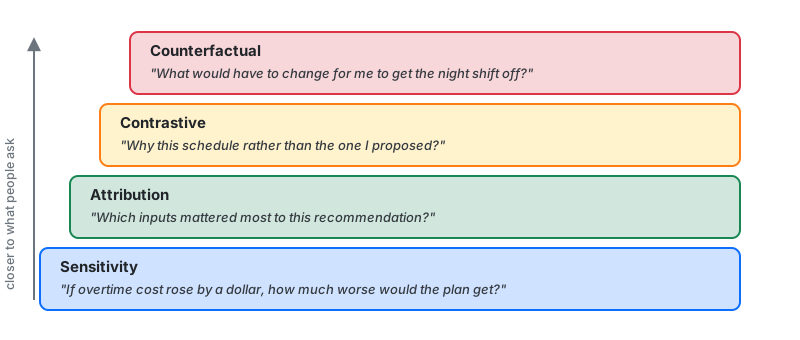
It helps to see the available techniques as a ladder. Each rung costs more to compute than the one below it, and each lands closer to the question a human would have asked in the first place.
| Technique | What it produces | What it costs |
|---|---|---|
| Sensitivity analysis | How the objective moves as a coefficient or resource limit changes | Nearly free — falls out of the solve itself, but only for linear models |
| Feature attribution | A score per input for how much it pushed the outcome one way | Many extra model evaluations; describes correlation, not mechanism |
| Unsatisfiable cores | The smallest set of constraints that makes a request impossible | Repeated re-solves; explains refusals, not preferences |
| Contrastive explanation | The measured penalty of the alternative the user wanted | One re-solve per alternative asked about |
| Counterfactual explanation | The smallest change to inputs that would flip the decision | An optimization problem in its own right, often harder than the original |
| Interpretable by design | A solution structured so it can be read — simple rules, regular patterns | Optimality: the readable answer is measurably worse than the best one |
The last row is the interesting one, because it changes what optimization is. Instead of finding the best schedule and explaining it afterwards, you constrain the search to schedules a person can hold in their head — a fixed rotation pattern, a small number of route shapes, a decision rule expressible as a short tree. You give up a percent or two of measured quality and buy something the model never had: a plan people will actually accept and follow.
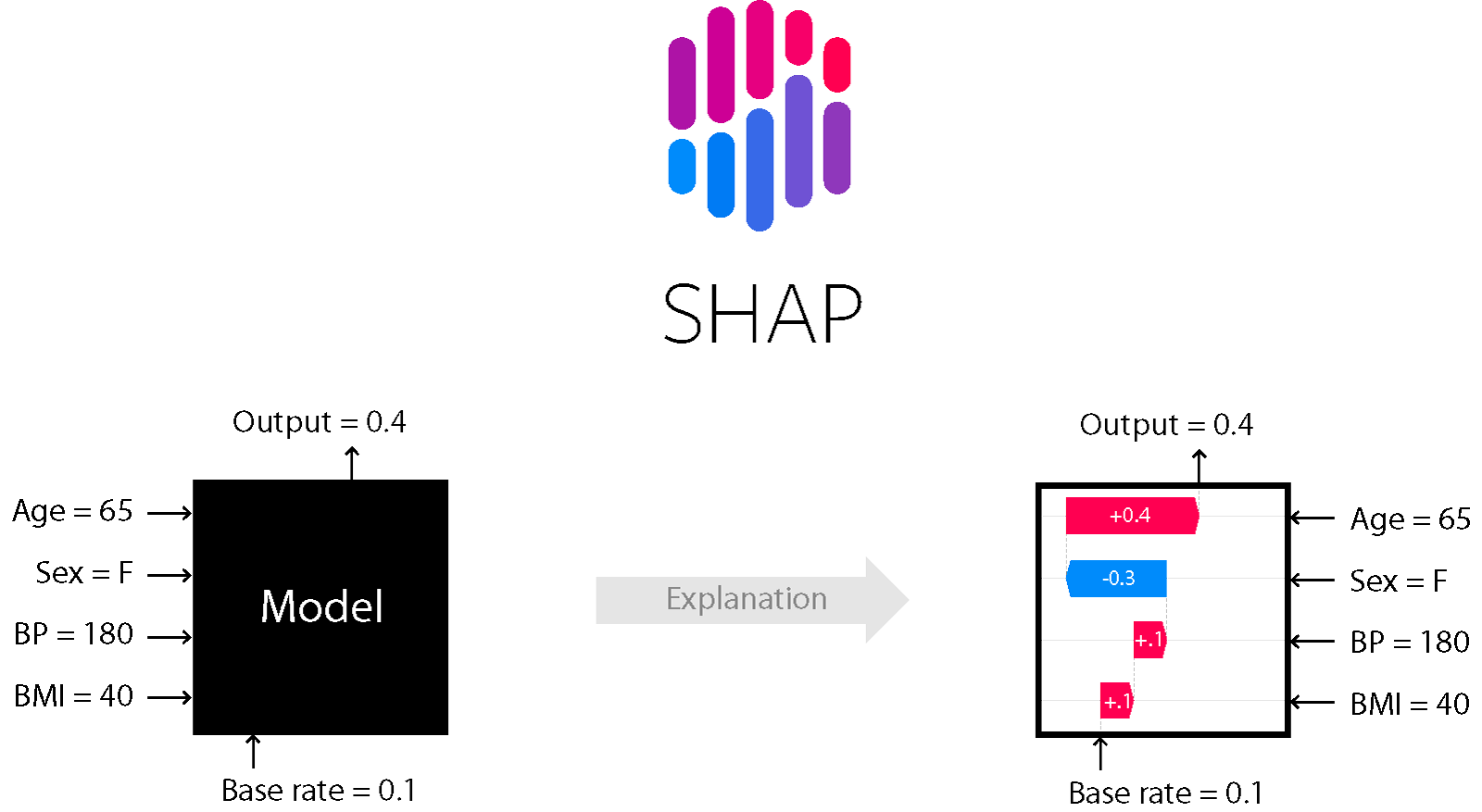
When the solver contains a learned component — a reinforcement learning policy dispatching jobs on a factory floor, say, or a model predicting which branch of a search tree to expand — the glass box is gone and the neural-network side of explainable AI becomes relevant. The most widely used tool there is SHAP, which distributes credit for a prediction across its inputs using a result from cooperative game theory.
This trend is partly technical and partly regulatory: decisions made about people are increasingly expected to come with reasons, and an optimization system is no less accountable for being mathematically optimal. The ethical dimension of that accountability is a topic in its own right; what matters here is that explainability is becoming a design requirement rather than a research curiosity.
Quantum and Quantum-Inspired Optimization
Start with a surprising fact rather than with physics. An enormous number of hard decision problems — partitioning a network, packing items, choosing a portfolio, scheduling machines, colouring a map — can be rewritten into one identical shape: assign each variable a value of 0 or 1, and minimize a total made only of individual terms and pairwise interactions between variables. That shape is called a QUBO (quadratic unconstrained binary optimization), and its physics twin, where variables take values of −1 or +1, is the Ising model borrowed from magnetism.
Why does one common format matter? Because it turns "build a solver for my problem" into "build a machine that minimizes Ising energy" — and that second machine can be built out of almost anything: superconducting circuits, laser pulses, analogue electronics, or ordinary silicon running a clever algorithm. Everyone building such hardware targets the same interface, and the model you write outlives the machine you run it on.
Annealing: settling instead of searching
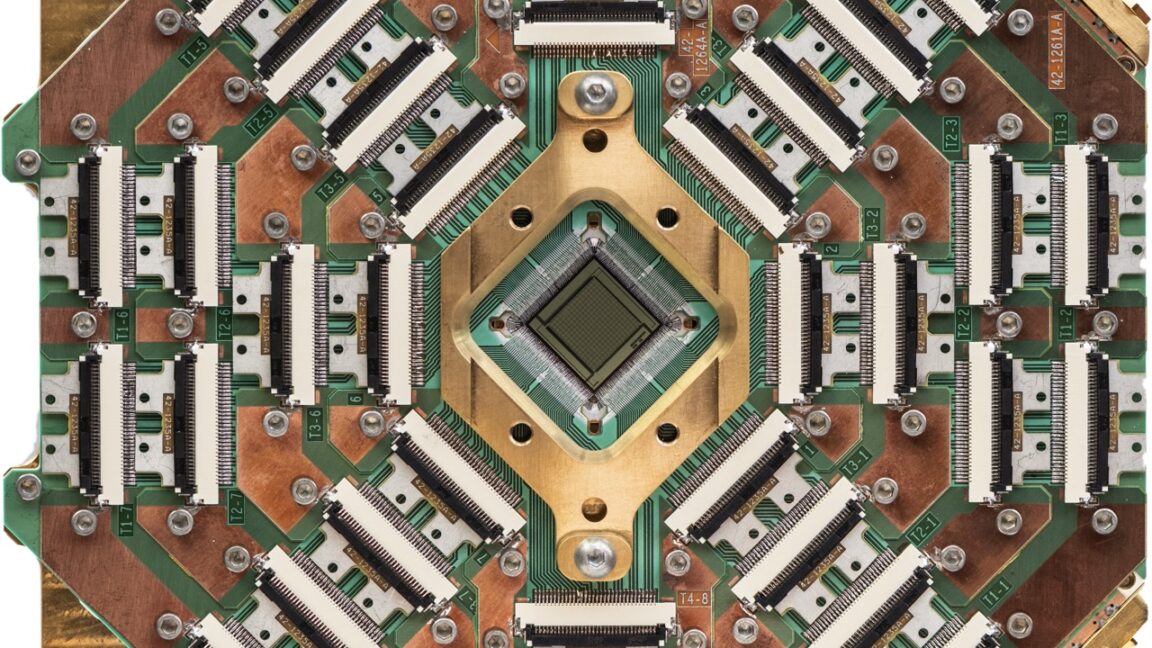
The oldest quantum optimization device is the quantum annealer, pictured at the top of this page. It does not execute instructions. The QUBO is physically embodied as an energy landscape over the machine's qubits, the system is started in a smeared-out quantum state, and the landscape is then tilted slowly into the shape of your problem. If the tilting is slow enough, the system stays near its lowest-energy configuration throughout — and when the run ends, reading the qubits reads out a good solution.
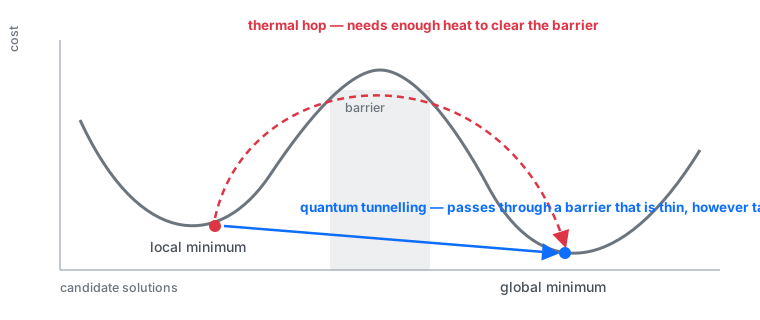
The claimed advantage over a classical method like simulated annealing is tunnelling. A thermal method escapes a bad valley by being kicked over the ridge, which requires enough energy to clear it. A quantum system can pass through a ridge that is tall but narrow.
QAOA: a tunable compromise
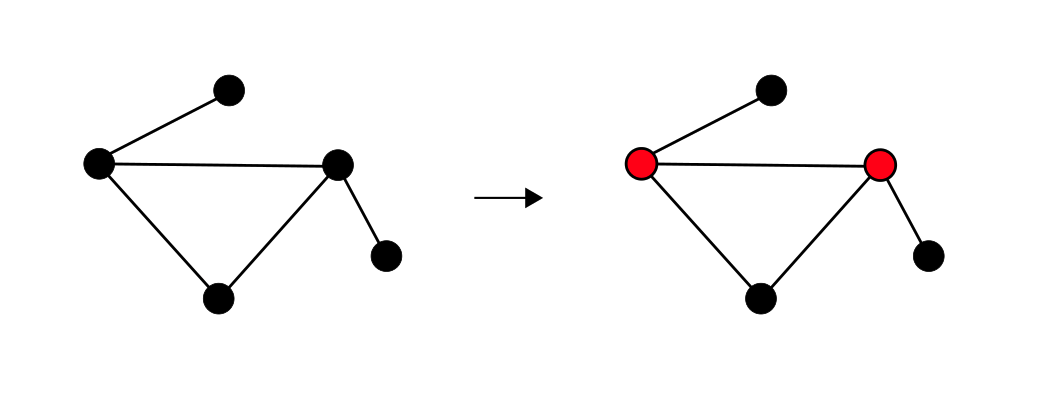
The gate-model equivalent is the Quantum Approximate Optimization Algorithm, or QAOA. The intuition without any circuit diagrams: prepare every possible answer at once as an equal superposition, then alternate two operations. The first nudges the phase of each candidate according to how good it is; the second mixes neighbouring candidates together so that good ones reinforce and bad ones cancel. Each pair of operations has a strength parameter, and a classical optimizer on an ordinary computer tunes those parameters between runs — making QAOA a hybrid method by construction, with a quantum sampler inside a classical loop.
Quantum-inspired: the physics without the physics
Here is the twist that makes this section relevant now rather than in a decade. Once your problem is an Ising model, you can attack it with hardware that borrows the dynamics of quantum or physical systems while remaining entirely classical — no cryogenics, no qubits, no error correction. These machines are available today, on ordinary cloud accounts, at ordinary prices.
That last point deserves emphasis rather than a footnote. The history of quantum optimization claims is a history of classical algorithms catching up: a machine reports a speedup, a classical method inspired by understanding why it worked matches or beats it within a year or two. This is not a failure of the field. It is arguably its most reliable output so far — quantum thinking has produced excellent classical algorithms.
A fair summary for a practitioner: reformulating your problem as a QUBO is a good investment today, because it opens the door to fast classical Ising solvers regardless of what quantum hardware does next. Buying quantum hardware time is a research activity, not a procurement decision — with the honest caveat that the field's own leading assessments consider the question of practical quantum advantage in optimization genuinely open rather than settled either way.
Solvers That Learn, and Solvers That Write Themselves
Classical solvers treat every problem instance as a stranger. Yet a delivery company routes the same city every morning, and a factory schedules the same machines every week. The instances differ in detail and are nearly identical in structure — and a method that starts from scratch each time is throwing that away.
The shift: from solving an instance to solving a distribution
- Train once, expensively. A model — often a graph neural network, since routes, networks and schedules are naturally graphs — learns on thousands of past instances.
- Infer many times, cheaply. At run time it produces a good solution, or a good starting point, in milliseconds rather than minutes.
- Keep the classical solver. In practice the learned part rarely replaces the solver; it predicts branching decisions, warm-starts the search, or prunes variables, and an exact method finishes the job.
- Accept the trade. You gain speed on instances that look like the training data, and lose all guarantees on instances that do not.
The more startling development is one level up: systems that search for algorithms rather than for solutions. A large language model proposes candidate programs, an automatic evaluator scores each one on the real problem, the survivors are fed back as inspiration for the next round, and the loop runs for thousands of generations. Structurally this is a genetic algorithm whose mutation operator happens to be a model that has read a great deal of code.
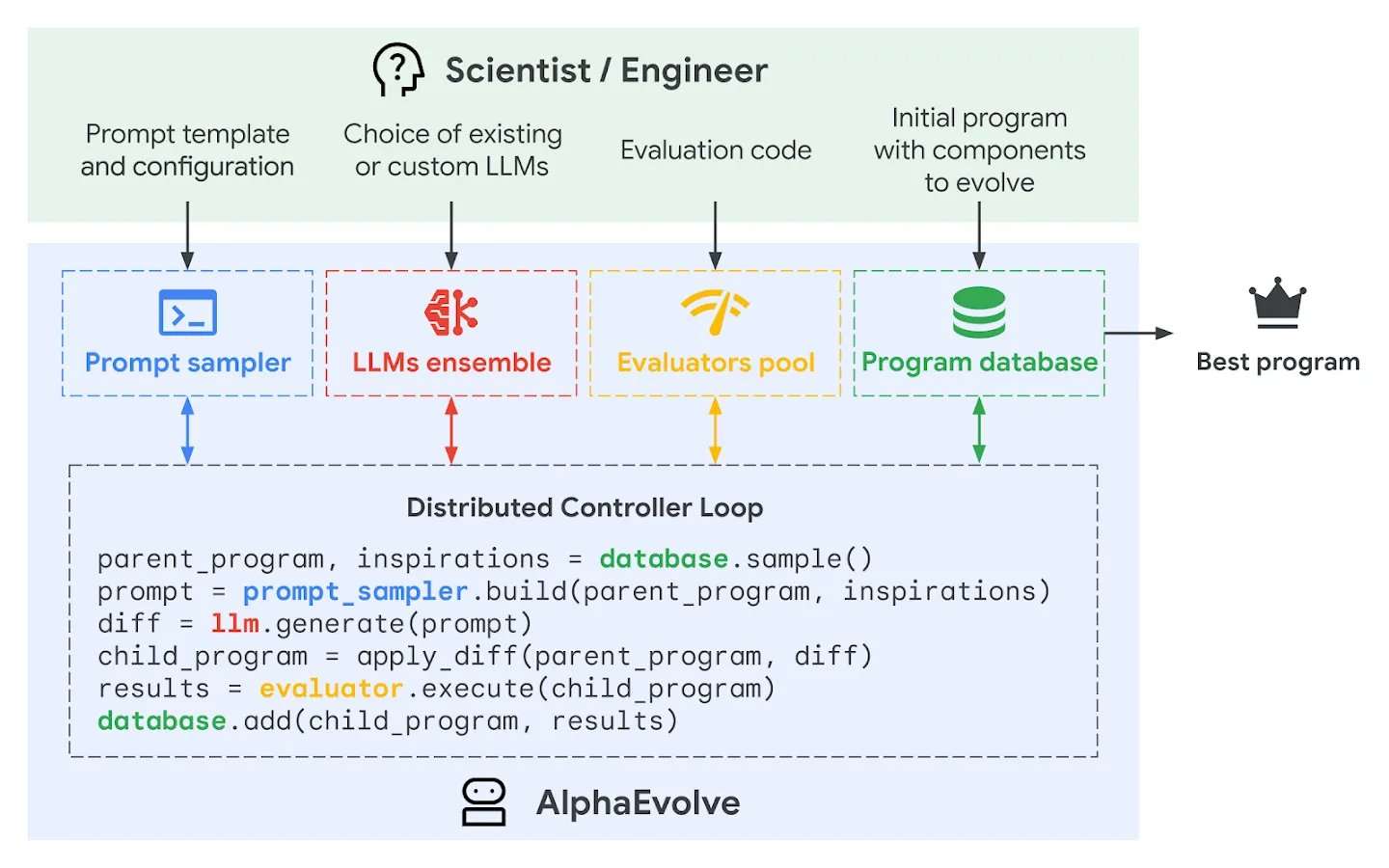
- Verification is cheap. A proposed heuristic can be run and scored automatically, so wrong ideas cost nothing and are discarded in seconds.
- The search space is code. Programs compose, so improvements accumulate in a way that tweaking numeric parameters does not.
- The output is readable. Unlike a learned policy, the result is a function a human engineer can inspect, modify and ship.
- The evaluator is the whole product. If your objective is not automatically checkable, none of this applies — and most real objectives are contested rather than checkable.
- It optimizes what you measure. A misspecified score is pursued relentlessly, a failure mode familiar from reward design.
- Cost is real. Thousands of model calls per discovered improvement is affordable for a data-centre-scale payoff and absurd for a small one.
The plausible near-term picture is neither "AI replaces solvers" nor "nothing changes". It is that heuristic design — historically a craft practised by a few hundred specialists — becomes partly automated, with humans specifying objectives, constraints and evaluators, and machines searching the space of methods that satisfy them.
Where the Solving Happens
A quieter trend concerns location and latency rather than intelligence. Optimization is migrating out of overnight batch jobs and into the loop: a warehouse re-plans as an order lands, a grid rebalances as a cloud passes over a solar farm, a vehicle re-routes as the road ahead closes.
These constraints push in the same direction as everything above: toward methods that are fast, approximate, aware of their own uncertainty, and capable of saying something intelligible about the answer they just produced.
What This Means for Industry
Predictions in this field age badly, so the useful thing is not a timeline but a readiness assessment: how mature each trend is, who is plausibly first to benefit, and what tends to break when someone tries.
| Trend | Maturity | First to benefit | What breaks first |
|---|---|---|---|
| Explainable optimization | Deployable now |
Workforce scheduling, healthcare, lending, public-sector allocation | Nobody owns the explanation; it is scoped as a UI feature, not a modelling requirement |
| Learned solver components | Early production |
High-volume repetitive planning: routing, dispatch, chip and network design | Distribution shift — the model is excellent until the operation changes |
| Quantum-inspired classical hardware | Available, niche |
Dense pairwise problems: portfolio selection, traffic assignment, layout | Penalty weights — constraints folded into the objective are violated or over-enforced |
| Automated algorithm discovery | Demonstrated at scale |
Organizations where a 1% heuristic gain is worth millions | The evaluator — a proxy objective gets optimized into something nobody wanted |
| Quantum hardware advantage | Research |
Nobody yet, for general optimization workloads | The classical baseline, once someone runs a serious one |
Read that table as a sequencing argument. The investments that pay off regardless of how the speculative rows resolve are the boring ones: clean problem formulations, honest baselines, instrumented objectives, and the ability to explain a decision to the person it lands on.
Open Research Directions
If you are choosing a problem to work on, these are the gaps that keep appearing across the literature above — and most of them are methodological rather than algorithmic.
Tools & Tutorials
- PennyLane: intro to QAOA — a runnable walkthrough that builds minimum vertex cover as an energy function and optimizes it, with the classical outer loop visible throughout.
- IBM Quantum Learning: QAOA tutorial — the same algorithm on real hardware, including the transpilation and error-mitigation steps that dominate practical cost.
- Qiskit Optimization tutorials — converting constrained programs into QUBOs, which is where most of the modelling effort actually goes.
- D-Wave Ocean documentation — the annealing toolchain, and notably its classical samplers, which let you build and test a QUBO model with no quantum hardware at all.
- Fixstars Amplify — one model definition dispatched to GPU-based, digital-annealer, and quantum back ends, which makes the quantum-inspired comparison concrete.
- SHAP and InterpretML — attribution for learned components, plus glass-box models worth trying before reaching for a post-hoc explanation.
- CPMpy's explanation tools — unsatisfiable cores and step-wise explanations for constraint models; see also the accompanying XCP-explain examples for scheduling problems.
- Captum — attribution methods for PyTorch models, useful when the learned component inside your solver is a network rather than a tree.
Further reading
- Lucas, A. (2014). Ising Formulations of Many NP Problems. — the reference cookbook: explicit Ising and QUBO encodings for partitioning, covering, colouring, routing and more. Read this before writing a single line of annealer code.
- Farhi, E., Goldstone, J. & Gutmann, S. (2014). A Quantum Approximate Optimization Algorithm. — the original QAOA paper, short and unusually readable for a foundational result.
- Abbas, A. et al. (2023). Challenges and Opportunities in Quantum Optimization. — a broad, deliberately sober assessment from a large group of practitioners; the best single source for calibrating expectations.
- Mohseni, N., McMahon, P. L. & Byrnes, T. (2022). Ising Machines as Hardware Solvers of Combinatorial Optimization Problems. Nature Reviews Physics. — the survey of the whole hardware zoo, quantum and classical, on equal footing.
- Kim, Y. et al. (2023). Evidence for the Utility of Quantum Computing Before Fault Tolerance. Nature. — worth reading together with the classical simulation responses it provoked; a case study in how advantage claims get tested.
- Romera-Paredes, B. et al. (2024). Mathematical Discoveries from Program Search with Large Language Models. Nature. — FunSearch: the evolve-and-evaluate loop that underpins the automated discovery work, described precisely enough to reimplement.
- Chen, T. et al. (2021). Learning to Optimize: A Primer and a Benchmark. — both an introduction to learned optimizers and an unusually candid account of how fragile their reported gains can be.
- Aydın, N., Birbil, Ş. İ. & Küçükparlak, İ. (2026). Explainable Optimization: A Call for Interdisciplinary Action. — argues that mathematical transparency is not explanation, and maps what optimization would need to borrow from human-computer interaction and the social sciences.
- Immordino, G. et al. (2025). Explainable AI for Reinforcement Learning Based Dynamic Scheduling Solutions in Semiconductor Manufacturing. Journal of Intelligent Manufacturing. — a concrete industrial case of explaining a learned scheduling policy, including where post-hoc explanations proved misleading.