"An optimizer never disagrees with you about what matters. It agrees with what you wrote down, relentlessly, long after you would have stopped."- Claude 2026
Ethical Considerations in AI Optimization
An optimization system is a machine for getting more of something. Point it at a well-specified goal and it will find answers no person would have found; point it slightly off, and it will pursue the wrong thing with exactly the same diligence, at a scale and a speed that no individual decision-maker could match. The ethical questions in this subject are not a soft appendix to the technical ones. They are technical questions — about what goes in the objective, what is left out of it, and who is standing where the consequences land.
Optimization means searching a space of possible answers for the one that scores best under some measure: the objective, a single number to be pushed up or down, subject to constraints that any legal answer must satisfy. Everything in this page follows from one property of that setup — the objective and the constraints are written by people, and the search takes them literally.

Learning objectives
By the end of this page you should be able to:
- Identify ethical issues in AI-driven optimization decision-making.
- Analyze the societal impacts of AI-based optimization techniques.
- Propose strategies for ensuring ethical practices in AI-driven optimization.
The Objective Is the Ethics
Ask what an optimization system values and there is a precise answer: read the objective function. Whatever is in it will be maximized. Whatever is not in it will be spent freely to buy more of what is — not out of malice, but because trading away an unmeasured quantity for a measured one is, by the system's own accounting, a strict improvement.
The gap that matters is between the outcome you care about and the measurement standing in for it. Almost nothing worth optimizing can be measured directly. Health is measured by spending. Teaching quality is measured by test scores. Content value is measured by watch time. Each substitution is reasonable, and each opens a wedge that gets wider the harder the system pushes.
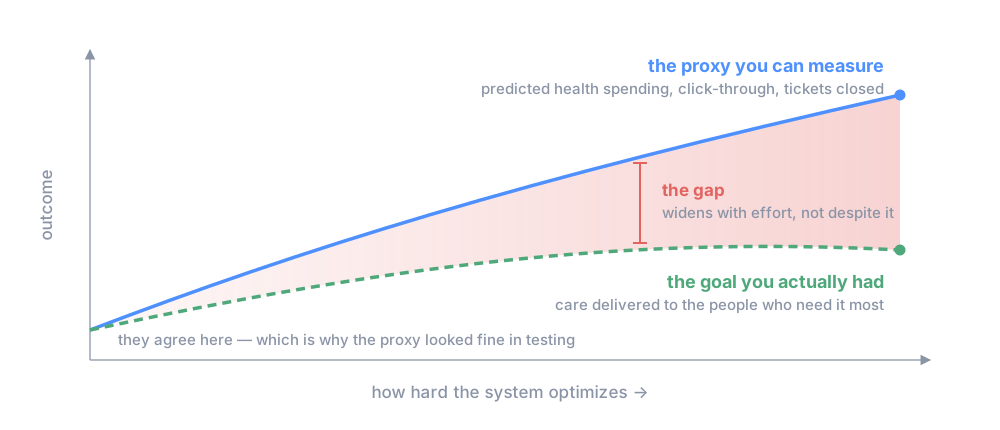
The same phenomenon has a name in the machine learning literature. When a system finds a way to score well that satisfies the letter of the objective and violates its evident intent, it is called specification gaming — a boat racing game where an agent learns to spin in circles collecting respawning points instead of finishing the course, a robot that learns to hover its gripper next to an object rather than pick it up. In a simulator this is funny. In a benefits agency it is not.
Before writing an objective, three questions decide most of what follows:
This is why "the algorithm decided" is never an accurate description of what happened. A genetic algorithm, an ant colony and a reinforcement learner are, ethically speaking, interchangeable: they are all machinery for satisfying a specification. The specification is where the human judgement went, and it is where accountability stays.
Where Harm Enters the Pipeline
Harm rarely enters as a single bad decision. It enters at identifiable points in an ordinary, competently built pipeline, and the useful skill is knowing where to look before deployment rather than after.
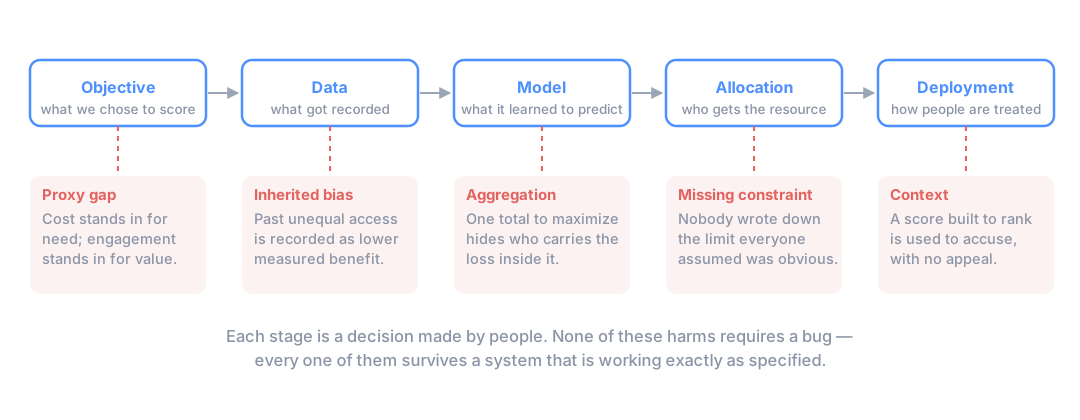
A proxy that encoded who had been served before
The clearest documented case concerns a commercial risk-prediction tool applied to roughly 200 million people in the United States each year, used to select patients for extra care-management resources. It did not use race as an input. It predicted future health-care costs, on the reasonable-sounding theory that costly patients are sick patients.
Two details make this the canonical example. First, the algorithm was working correctly: it predicted cost accurately for everyone. Second, the fix was not a fairness constraint bolted on afterwards — it was changing what the system predicts, from cost to a direct measure of health. The bias lived in the objective, and that is where it had to be repaired (Obermeyer et al., Science, 2019; the Berkeley News summary is the readable version).
A system optimized for enforcement, deployed against families
In the Netherlands, tax authorities used automated risk-scoring to prioritize investigation of childcare benefit claims. Tens of thousands of families were wrongly accused of fraud and ordered to repay sums many could not pay; households were driven into debt, and more than a thousand children were placed in foster care. Having a second nationality functioned as a risk indicator. The government resigned over it in January 2021 — and reporting later showed similar neighborhood-level profiling continuing afterwards.
The last entry point is subtler than the others and is worth its own picture, because it is the mechanism that makes a biased optimizer look increasingly correct over time (Lighthouse Reports, "The Algorithm Addiction").
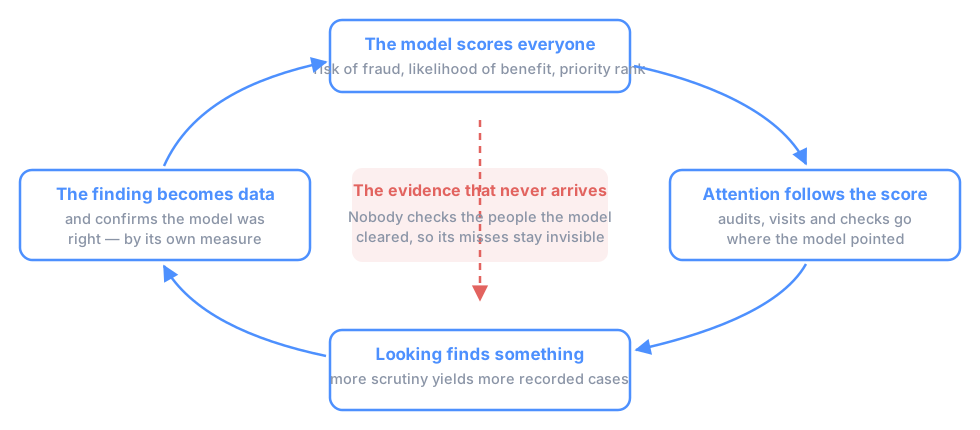
Notice that this is a dynamic-environment problem wearing different clothes: the system's own decisions change the distribution it will be evaluated on next. Static offline validation cannot see it, because the effect only exists once the system is in the loop.
Efficiency Versus Equity, Concretely
"Be fair" is not implementable. What is implementable is a choice among objectives with different distributional consequences — and the honest way to teach that choice is to price it. Consider a small allocation problem of exactly the kind covered in resource management: 120 community health worker visits to distribute across three neighborhoods, where the measured benefit per visit differs.
| Neighborhood | Measured benefit per visit | Why it differs |
|---|---|---|
| A | 1.0 | Dense, well-documented, easy to reach; outcomes are recorded reliably |
| B | 0.7 | More travel time per visit, patchier records |
| C | 0.4 | Dispersed, historically underserved, thin data — so measured benefit is low |
Take the numbers at face value and run three defensible objectives. Each is a legitimate reading of "allocate these visits well," and they do not resemble each other:
| Objective | Visits (A / B / C) | Total benefit | Worst-served gets | Cost vs. max |
|---|---|---|---|---|
| Maximize the total | 120 / 0 / 0 | 120.0 | 0.0 | — |
| Guarantee a floor (20% each) | 72 / 24 / 24 | 98.4 | 9.6 | 18% |
| Equalize benefit received | 24 / 35 / 61 | 73.0 | 24.3 | 39% |
The first row is what an unconstrained optimizer returns, and it is not a caricature: maximizing a sum over groups with unequal returns concentrates everything on the best group by construction. Two entire neighborhoods receive nothing, and no metric in the objective registers that as a problem.
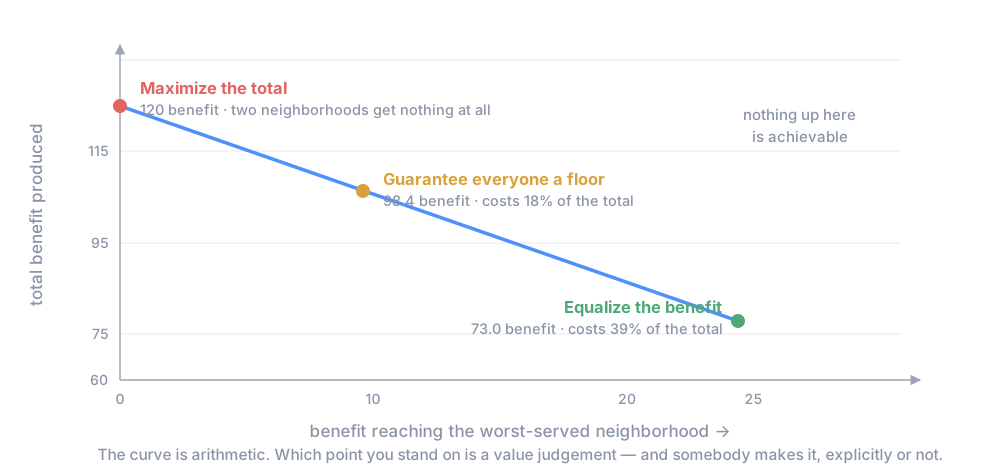
Presenting the frontier rather than a single answer is itself the ethical practice here. A team that reports "our system produces 120 units of benefit" has hidden a distributive decision inside an engineering result; a team that reports the curve has surfaced it.
Why you cannot simply satisfy every fairness definition
A natural response is to demand that the system be fair in all the obvious senses at once: scores that mean the same thing for everyone, and equal error rates across groups. Two results show this is not a matter of trying harder.
And a caution about the frame itself: fairness metrics quietly assume the system should exist and the decision should be made this way. Selbst and colleagues call this the framing trap — solving for a mathematically fair allocation of a resource that is scarce only because of an upstream policy choice can lend technical legitimacy to the scarcity. Amsterdam's pilot ended not with a better metric but with a decision not to deploy.
Societal Impacts at Scale
Individual harms are the visible part. The structural effects come from the same systems working as designed, across millions of decisions.
Against these, the genuine benefits are not in doubt and should not be waved away — the same techniques cut delivery emissions in logistics, schedule renewable generation, shorten organ-matching chains and reduce waste in supply chains. The ethical question is never "optimization: yes or no." It is: whose gains, whose costs, and who was in the room when the objective was written?
The distributional question, in four parts
Strategies for Ethical Practice
What follows is ordered deliberately: the earliest items are cheap and prevent the most, and no amount of later machinery compensates for skipping them.
| Stage | Practice | What it actually catches |
|---|---|---|
| Before any model | Write the objective and the outcome you meant side by side, and name the gap in plain language | The proxy failure of §1 — the single highest-yield half hour in the project |
| Before any model | Ask whether the decision should be automated at all, and what happens to those affected if it is wrong | Systems whose worst case is unrecoverable, which no fairness metric will rescue |
| Data | Document provenance, collection conditions and who is underrepresented — a datasheet | Measured-benefit gaps that are really measurement gaps |
| Objective design | Encode non-negotiables as hard constraints, not weighted penalty terms | Optimizers trading away a value because the penalty was finite and the reward was larger |
| Evaluation | Report distributions and subgroup error rates, never a single aggregate; publish the trade-off frontier | Concentrated harm hidden inside a good average — §3's first row |
| Release | State intended use, tested populations and out-of-scope uses in a model card | A ranking tool repurposed as grounds for accusation |
| Deployment | Meaningful human review, with authority and time to overturn — and an explanation the affected person can act on | Rubber-stamping; errors that are individually recoverable but never actually recovered |
| Operation | Monitor subgroup outcomes over time and sample the cases the system cleared | The self-sealing feedback loop of §2, which is invisible without deliberate counter-sampling |
Two governance frameworks are worth knowing by name, because they increasingly determine what "reasonable practice" means in an audit or a courtroom:
Underneath both sits a simpler principle worth carrying out of this page: a person subject to an automated decision should be able to find out that it happened, learn the reasons in terms they can act on, and get it reviewed by someone empowered to change it. In the EU that has a legal anchor in GDPR Article 22; counterfactual explanations — "your application would have been approved had your income been £45,000" — are one technical route to the actionable half of it. Contestability is not a courtesy bolted onto an optimization system. It is the mechanism by which the system's errors ever come back to be fixed.
Tools & Tutorials
- Attacking discrimination with smarter machine learning — an interactive explorable from Google's PAIR team: drag the decision threshold on a simulated loan model and watch group-level error rates, profit and each fairness definition move against each other. The fastest way to feel §3's impossibility result rather than read it.
- Survival of the Best Fit — a short browser game in which you hire candidates by hand, then hand your decisions to a model trained on them; it reproduces the §2 feedback loop in about ten minutes and is well suited to opening a class discussion.
- Fairlearn — open-source Python toolkit for assessing subgroup performance and applying mitigation algorithms, with a user guide that is unusually candid about which harms its metrics can and cannot capture.
- What-If Tool — a visual, no-code interface for probing a trained model: edit a datapoint and see the prediction change, compare counterfactuals, and impose fairness criteria post hoc to see what each costs.
- AI Fairness 360 and Aequitas — complementary audit libraries: AIF360 offers a wide catalogue of metrics and mitigation algorithms with notebook tutorials, while Aequitas is built around producing a bias report for a specific decision context.
- AI Incident Database — a searchable, citation-backed record of deployed systems that caused harm; useful as a source of case material and as a reality check on how ordinary these failures are.
Further reading
- Obermeyer, Z., Powers, B., Vogeli, C. & Mullainathan, S. (2019). Dissecting racial bias in an algorithm used to manage the health of populations. Science, 366(6464), 447–453. — the full study behind §2, including how the authors obtained the algorithm's outputs and what changing the target variable did.
- Kleinberg, J., Mullainathan, S. & Raghavan, M. (2016). Inherent Trade-Offs in the Fair Determination of Risk Scores. — the impossibility theorem, readable with modest probability background.
- Chouldechova, A. (2016). Fair prediction with disparate impact: A study of bias in recidivism prediction instruments. — the same tension worked through on a real, contested deployment.
- Selbst, A. et al. (2019). Fairness and Abstraction in Sociotechnical Systems. ACM FAT*. — five traps that catch teams who treat fairness as a property of a model rather than of a system embedded in institutions.
- Manheim, D. & Garrabrant, S. (2018). Categorizing Variants of Goodhart's Law. — a precise taxonomy of the ways optimizing a proxy diverges from optimizing the goal, and which mitigations apply to which variant.
- Bertsimas, D., Farias, V. F. & Trichakis, N. (2011). The Price of Fairness. Operations Research, 59(1). — the formal treatment of §3's frontier, with bounds on how much efficiency fairness costs in resource allocation.
- Mitchell, M. et al. (2019). Model Cards for Model Reporting, and Gebru, T. et al. (2021). Datasheets for Datasets. — the two documentation practices from §5, both short and immediately usable as templates.