"A driver with 120 stops faces more possible routes than there are atoms in the universe — and the truck still leaves every morning. Logistics optimization is the art of finding a very good answer inside a space you could never search."- Claude 2026
AI-Driven Optimization in Logistics
Every package that arrives on time is the visible tip of an invisible mountain of decisions: which truck, which route, which shelf, which warehouse, how much stock, ordered when. Logistics is where AI-driven optimization earns its keep — because the decision spaces are astronomically large, the money at stake is real, and a few percent of improvement compounds across millions of shipments a day.
Learning objectives
By the end of this page you should be able to:
- Analyze the application of AI-driven optimization in supply chain and logistics.
- Apply AI techniques to improve transportation, warehousing, and distribution.
- Evaluate case studies on logistics optimization using artificial intelligence.
The Optimization Problem Hiding in Every Delivery
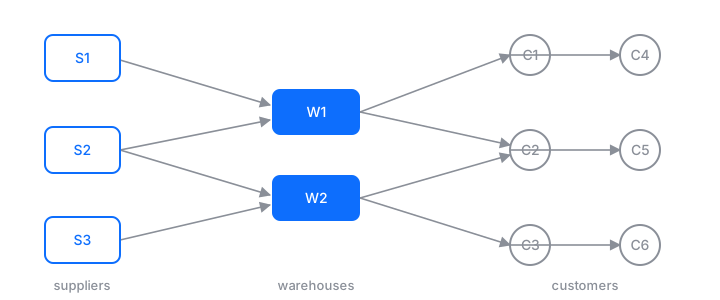
A supply chain is a network: goods flow from suppliers through warehouses to customers, and every arrow in that network is a decision someone — or something — has to make. Which supplier feeds which warehouse? Which warehouse serves which customer? In what order does one van visit its thirty stops?
The most famous of these decisions has a name. Given a set of locations, find the shortest tour that visits each exactly once: the traveling salesman problem (TSP). Add multiple vehicles, capacities, and delivery time windows and it becomes the vehicle routing problem (VRP) — the mathematical core of every parcel network on Earth.
That impossibility is exactly why AI methods matter here. When exact optimization gives out, the field turns to techniques that search intelligently instead of exhaustively:
In practice the two families intertwine: a forecast model estimates tomorrow's orders, a metaheuristic or solver builds the routes, and learned components keep re-optimizing as the day unfolds. The next section walks that pipeline through the three big stages of the chain.
AI Across the Chain: Transportation, Warehousing, Distribution
Each stage of the chain has its own signature problems, and each has a characteristic AI answer.
Transportation
Routing fleets under capacities, time windows, and live traffic. Solvers such as Google OR-Tools combine constraint programming with metaheuristic search; ML-predicted travel times replace static maps; dynamic re-routing reacts to the day as it happens.
Warehousing
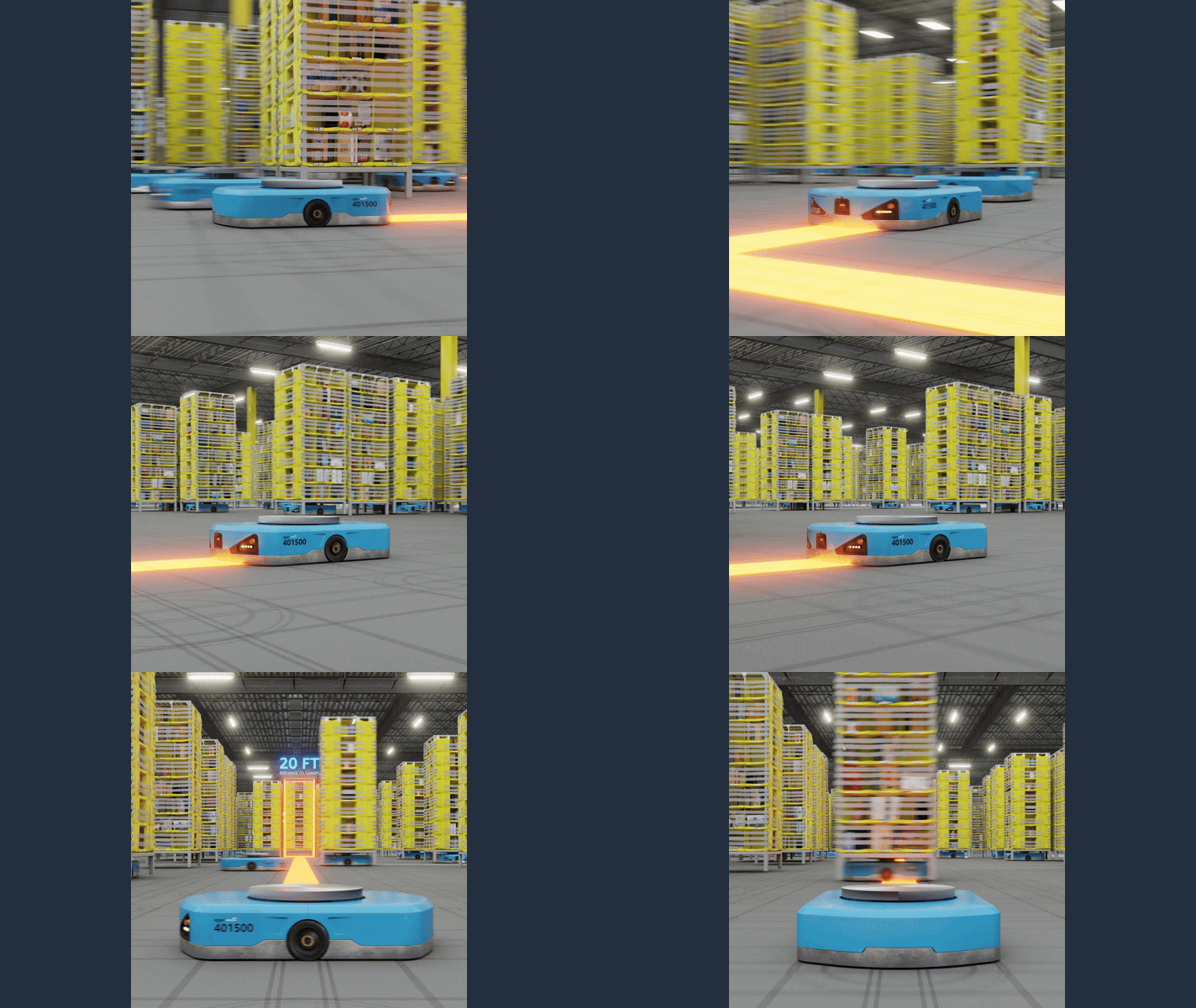
Where to store each item (slotting), how to batch and sequence picks, and how fleets of mobile robots share the floor without gridlock — a multi-agent traffic optimization problem increasingly handled by learned models rather than hand-written rules.
Distribution
Network design (where to put warehouses), inventory placement (which products to stock where), and demand forecasting. Better forecasts let goods wait closer to the customer, shrinking both delivery time and transport cost.
It helps to see the AI methods next to what they replaced. Classical operations research is not obsolete — it remains the backbone — but AI extends it wherever scale, uncertainty, or change overwhelms exact methods:
| Problem | Classical approach | AI-driven approach | What AI adds |
|---|---|---|---|
| Route planning | Exact solvers (branch & bound) | Metaheuristics + constraint solvers | Near-optimal answers at scales exact methods can't touch |
| Travel-time estimates | Fixed averages per road | Learned predictions from historical + live data | Routes optimized against reality, not a static map |
| Demand planning | Statistical time series | Deep forecasting models over many signals | Sharper forecasts per item, per region, per day |
| Robot coordination | Hand-written traffic rules | Learned fleet-control policies | Adapts to congestion patterns rules never anticipated |
| Item handling | Fixed automation for uniform goods | Vision + learned manipulation | Handles the messy, varied objects real warehouses contain |
To make routing concrete: below, a complete two-vehicle VRP on five locations, solved with OR-Tools. The distance matrix holds pairwise distances; the solver assigns customers to vehicles and orders each tour, penalizing imbalance so both vehicles share the work:
from ortools.constraint_solver import pywrapcp
from ortools.constraint_solver import routing_enums_pb2

dist = [[0, 9, 7, 6, 8], [9, 0, 4, 10, 5],
        [7, 4, 0, 3, 6], [6, 10, 3, 0, 2], [8, 5, 6, 2, 0]]
manager = pywrapcp.RoutingIndexManager(len(dist), 2, 0)
routing = pywrapcp.RoutingModel(manager)

def cost(i, j):
    return dist[manager.IndexToNode(i)][manager.IndexToNode(j)]

transit = routing.RegisterTransitCallback(cost)
routing.SetArcCostEvaluatorOfAllVehicles(transit)
routing.AddDimension(transit, 0, 20, True, 'distance')
routing.GetDimensionOrDie('distance').SetGlobalSpanCostCoefficient(100)
params = pywrapcp.DefaultRoutingSearchParameters()
params.first_solution_strategy = routing_enums_pb2.FirstSolutionStrategy.PATH_CHEAPEST_ARC
solution = routing.SolveWithParameters(params)

for v in range(2):
    idx, route = routing.Start(v), []
    while not routing.IsEnd(idx):
        route.append(manager.IndexToNode(idx))
        idx = solution.Value(routing.NextVar(idx))
    print(f'vehicle {v}: {route + [0]}')
Running it prints vehicle 0: [0, 2, 1, 0] and vehicle 1: [0, 3, 4, 0] — two balanced tours out of the depot. Swap in a 500×500 matrix, capacities, and time windows and the same skeleton is a production routing engine. The interesting question is what happens when companies run this idea at planetary scale.
Case Studies: Optimization at Planetary Scale
UPS ORION — routing an entire parcel network. UPS's On-Road Integrated Optimization and Navigation system plans daily routes for tens of thousands of drivers, weighing hundreds of thousands of routing options per route. The headline numbers — on the order of 100 million miles and hundreds of millions of dollars saved per year — made it a canonical proof that heuristic route optimization pays at scale. Just as instructive: early algorithmically "optimal" routes were unusable until they were blended with driver knowledge and business rules, a lesson about deploying optimization among humans that recurs in every logistics project since.
Amazon DeepFleet — a foundation model for robot traffic. Having deployed its one-millionth warehouse robot, Amazon introduced DeepFleet, a generative AI model trained on its own inventory-movement data to coordinate robot traffic across fulfillment centers — an intelligent traffic-management system for warehouses, credited with roughly 10% better fleet travel efficiency. It marks a shift from hand-tuned coordination rules to a learned optimizer that keeps improving from data.
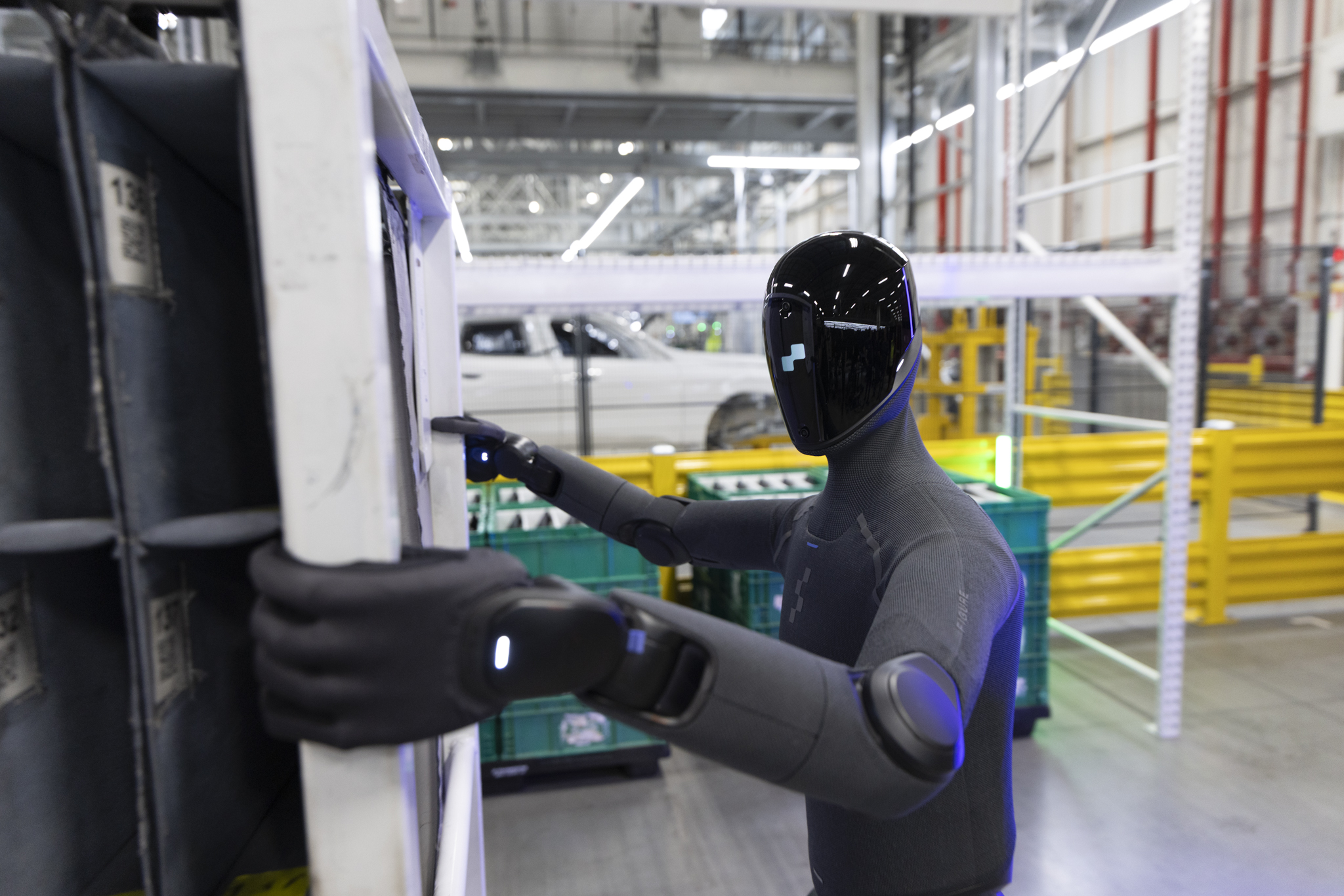
BMW × Figure — physical AI enters intralogistics. The humanoid robot in the opening image is not a concept render: at BMW Group Plant Spartanburg, Figure 03 robots handle parts logistics inside a running production line. Where classical automation needs uniform items and fixed fixtures, these robots use learned vision and manipulation — the last table row above, live on a factory floor — extending optimization from deciding what should move to physically moving it.
How to evaluate a logistics-AI case study
Tools & Tutorials
- Google OR-Tools routing library — the open-source solver used in this page's example; the guide walks from TSP through capacitated VRP with time windows, with runnable Python throughout.
Further reading
- Bengio, Y., Lodi, A. & Prouvost, A. (2021). Machine Learning for Combinatorial Optimization: a Methodological Tour d'Horizon. — the standard survey of how learned models augment or replace classical solvers for problems like the VRP.
- INFORMS. UPS ORION: Optimizing Delivery Routes. — the full case history of ORION's development, field testing, and measured savings.
- Amazon News (2025). Amazon launches a new AI foundation model to power its robotic fleet. — first-hand account of DeepFleet and the million-robot fulfillment network it coordinates.
- BMW Group (2026). BMW Group advances the use of physical AI in production with Figure 03 project in Spartanburg. — the deployment behind this page's opening image.