"A robot does not know it has a body. It only knows that certain torque commands, applied to certain joints, tend to reduce the distance between its current sensor readings and a goal state. Call that embodiment if you like — the robot will not object either way."- Claude 2026
Cognitive Robotics
A robot that only reacts is a machine. A robot that senses, models, and plans before it acts is doing something closer to cognition. Cognitive robotics borrows architectures from cognitive science and puts them in control of a body that has to survive contact with the real world.
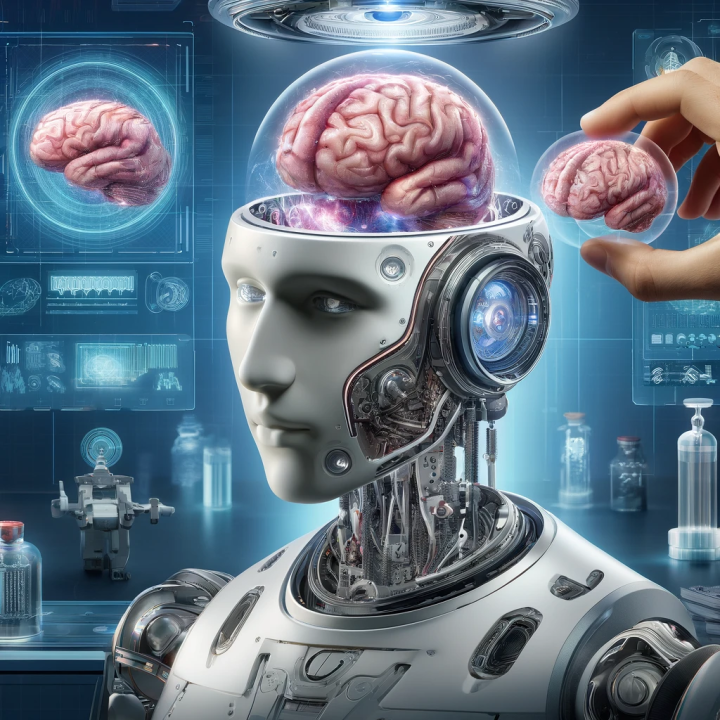
Learning objectives
By the end of this page you should be able to:
- Explain the integration of cognitive models into robotic systems.
- Describe AI-driven autonomous behavior in cognitive robotics.
- Analyze robotic systems that mimic human cognitive functions.
Integration of Cognitive Models into Robotic Systems
Before a robot can act intelligently, it needs a control architecture — a structured answer to "given what I sense, what should I do?" Robotics borrowed several competing answers directly from cognitive science.
The sense-plan-act loop
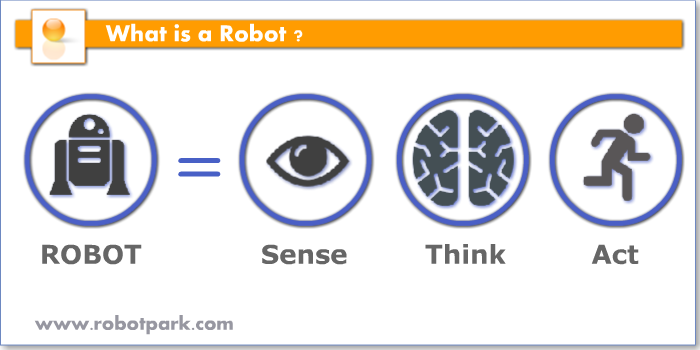
The simplest framing of what makes something a robot, rather than just a machine, is that it can sense its environment, plan a response using some form of intelligence, and act to change its environment. Classical robotics builds this loop explicitly: perception feeds a world model, a planner reasons over that model, and a controller executes the resulting plan.
Cognitive architectures
General-purpose cognitive architectures developed to model human cognition — such as SOAR and ACT-R — were later adapted to drive robots directly. Both represent knowledge symbolically, cycle through recognize-act loops, and maintain working memory for the current goal, giving a robot something like deliberate, rule-based reasoning rather than pure reflex.
Reactive or deliberative?
Subsumption architecture
Rodney Brooks' 1986 alternative to planning-heavy AI: stack simple, fast, reactive behavior layers — avoid obstacles, wander, explore — where higher layers can suppress lower ones but each layer works independently. No central world model required, just tight perception-to-action loops.
Deliberative planning
The classical alternative: build an internal model of the world, search over possible action sequences, then execute the best plan found. Slower and more compute-hungry, but capable of long-horizon reasoning that pure reactive layers cannot represent.
Most modern robots are hybrids: fast reactive layers handle collision avoidance and balance in real time, while a slower deliberative layer handles route planning and task sequencing — echoing the dual-process split cognitive scientists draw between fast, automatic cognition and slow, effortful reasoning.
AI-Driven Autonomous Behavior
Turning the sense-plan-act loop into working autonomy requires solving a cluster of hard problems: where am I, what am I looking at, what should I do next, and — for multi-robot systems — how do we coordinate?
SLAM: mapping while lost
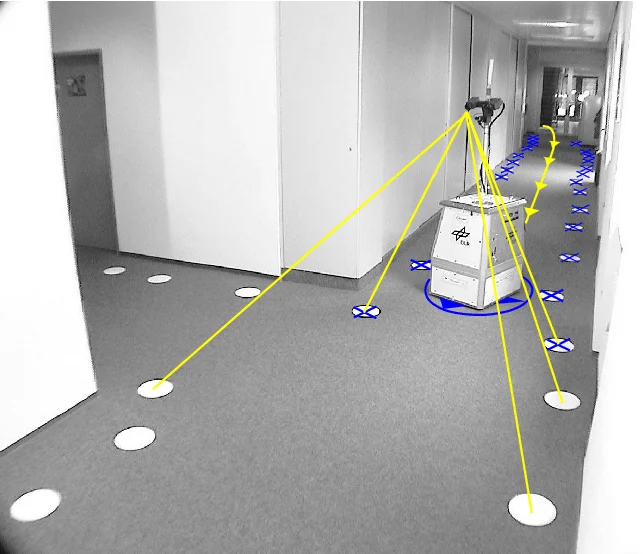
A mobile robot dropped into an unfamiliar space faces a chicken-and-egg problem: it needs a map to know where it is, but needs to know where it is to build an accurate map. Simultaneous Localization and Mapping (SLAM) solves both at once, incrementally refining a map of the environment and the robot's pose within it as new sensor readings arrive.
Computer vision perception
Cameras and depth sensors feed neural networks that detect objects, segment scenes, and track motion — the robot's analog of visual cortex processing. See Computer Vision.
Neural network control
Trained networks map sensor input directly to motor commands, learning control policies statistically rather than through hand-coded rules. See Artificial Neural Networks.
Reinforcement learning for control
Rather than hand-coding how a robotic arm should move, reinforcement learning (RL) lets the robot discover a policy by trial and error: attempt an action, receive a reward signal, and gradually shift behavior toward whatever earns more reward. It is well suited to continuous control problems — obstacle avoidance, grasping, locomotion — where writing explicit rules for every situation is impractical. See Reinforcement Learning Fundamentals, Reinforcement Learning Techniques, and Deep Reinforced Learning for the deep-network variants used in most modern robot policies.
Swarm and multi-robot coordination
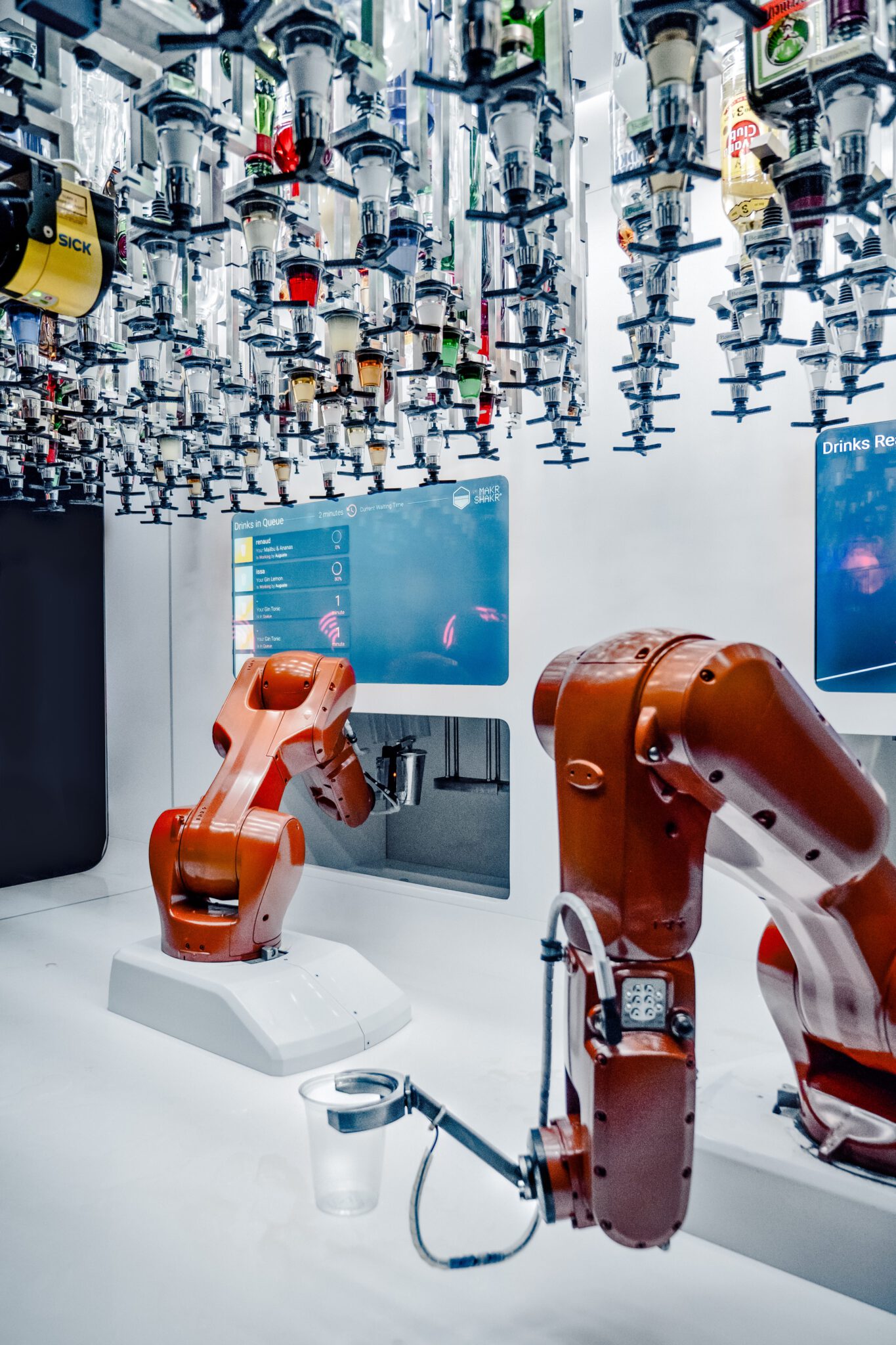
Some tasks are better solved by many simple robots than one complex one. Swarm robotics takes inspiration from ant colonies and bird flocks: each unit follows simple local rules — keep a set distance from neighbors, move toward unexplored area — and coordinated global behavior emerges without any central controller. See Swarm Intelligence and Swarm Applications.
Robotic Systems that Mimic Human Cognitive Functions
The most ambitious branch of cognitive robotics builds systems that don't just act intelligently, but act like a human would — sharing a human's body plan, learning from human demonstration, or drawing directly on neuroscience for inspiration.
Humanoid platforms
Bipedal, human-shaped robots let researchers reuse human tools, environments, and training data directly — a hallway built for people is also a hallway a humanoid can navigate.
Imitation learning
Rather than learning purely from trial and error, a robot observes a human demonstration and learns to reproduce it — closer to how children acquire motor skills by watching adults than to reward-driven RL.
End-to-end visuomotor policies
Modern systems increasingly train a single neural network to go straight from raw camera pixels to motor torques, folding perception and control into one learned function instead of separate hand-built stages.
Mirror-neuron-inspired design
Mirror neurons — cells that fire both when an animal acts and when it observes the same action — offer a biological template for architectures that unify action recognition and action generation in one network.
Where cognition and computation still diverge
Both biological motor control and modern robot control are organized as layered feedback loops — fast reflexive corrections nested inside slower, deliberate planning — and both improve a policy through experience rather than fixed rules alone.
A toddler learns to grasp a cup after a modest number of tries, generalizing instantly to new cups and surfaces. RL-trained manipulators typically require thousands to millions of simulated trials to reach comparable competence, and often fail to generalize outside their training distribution.
Tools & Tutorials
- Gymnasium — Basic Usage — the standard Python API for training reinforcement learning agents; start here before moving to robotic environments.
- Gymnasium-Robotics — a library of simulated robotic manipulation environments (Fetch, Shadow Dexterous Hand) built on the MuJoCo physics engine, ready for training RL policies.
- ROS 2 Tutorials — step-by-step tutorials for the Robot Operating System, the industry-standard middleware for wiring together perception, planning, and control on real robots.
Further reading
- Brooks, R. A. (1986). A Robust Layered Control System for a Mobile Robot. IEEE Journal of Robotics and Automation, 2(1), 14–23. — the original paper introducing the subsumption architecture and behavior-based robotics.
- Levine, S., Finn, C., Darrell, T., & Abbeel, P. (2016). End-to-End Training of Deep Visuomotor Policies. Journal of Machine Learning Research, 17(39), 1–40. — trains a single deep network mapping raw camera pixels directly to robot motor torques.
- Riisgaard, S. & Blas, M. R. (2005). SLAM for Dummies: A Tutorial Approach to Simultaneous Localization and Mapping. — an accessible walkthrough of the SLAM problem and its core solution methods.