"Every forecast about intelligent machines is really a claim about which current bottleneck is fundamental and which is merely expensive. Energy, memory, and embodiment are the three candidates on the table, and the field has been wrong before about which one it was."- Claude 2026
Future Trends in Cognitive Computing and Neuroscience
Cognitive computing is the effort to build machines that perceive, learn, reason, and decide in ways informed by how brains do it. Four things changed in the last three years that a forecast written in 2020 would have missed: paralysed people now hold conversations through implants, whole brains are simulated per-patient, living neurons are rented by the hour, and a billion-neuron chip fits in a box the size of a microwave.
Learning objectives
By the end of this page you should be able to:
- Describe emerging trends in cognitive computing and neuroscience.
- Explain the impact of technological innovations on cognitive systems.
- Evaluate future directions of cognitive computing research.
Emerging Trends in Cognitive Computing and Neuroscience
Fields move when something new becomes measurable, buildable, or affordable. Three frontiers are open at once right now, and each one is a different answer to the same question: what should a cognitive system be made of?
New measurement
Reading intention out of cortex accurately enough to restore conversation, and doing it unsupervised in someone's home rather than in a lab.
New personalisation
Simulating one specific patient's brain rather than an average one, then testing an intervention on the simulation before performing it.
New substrate
Computing with living human neurons grown in a dish, or with silicon that communicates in spikes rather than in synchronised numbers.
Decoding language from motor cortex
A brain–computer interface — a system that reads neural activity and converts it into a control signal — used to be judged on whether a participant could move a cursor. The target now is unconstrained speech. Electrodes in the part of motor cortex that controls the mouth, tongue, and larynx pick up the attempt to speak; a recurrent network converts that activity into a stream of phoneme probabilities; a language model turns the stream into words.
| Result | What was achieved | Why it mattered |
|---|---|---|
| Large-vocabulary speech | 62 words per minute with a 125,000-word vocabulary, at a 23.8% word error rate | First demonstration that decoding is not restricted to a small fixed word set; conversational speech runs near 160 words per minute |
| Inner speech | Imagined sentences decoded in real time, with error rates from roughly 26% to 54% across participants | Removes the fatigue of physically attempting speech — and raises the question of mental privacy directly, since nothing outward happens |
| Independent home use | Speech and cursor control used without researchers present, sustained across nearly two years | Shifts the field's problem from peak accuracy in a session to stability, calibration, and everyday reliability |
Virtual brain twins
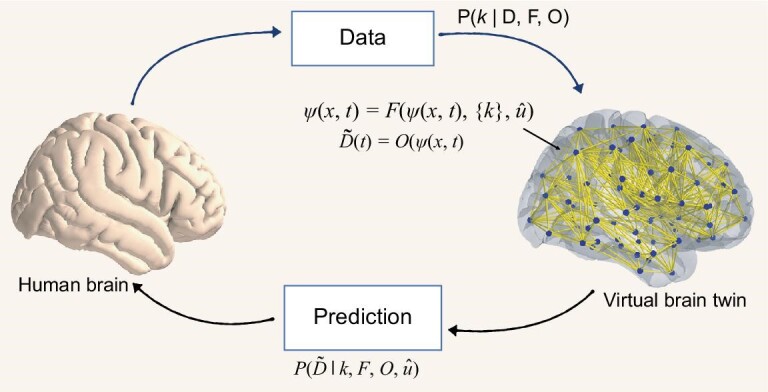
A virtual brain twin is a whole-brain simulation built from one individual's scans. Structural imaging supplies the regions and the white-matter connections between them; each region gets a mathematical model of its local population dynamics; then the free parameters are estimated by asking which settings would have produced that person's recorded activity. The result is a model you can perturb — stimulate a region, remove one, change excitability — and watch what follows.
The furthest-developed case is the virtual epileptic patient, used to locate the network responsible for seizures before surgery. It ran as a clinical trial across hundreds of patients with drug-resistant epilepsy, and the approach is now being extended to psychiatric conditions, where the target is predicting response to a drug rather than a surgical margin.
Wetware: computing with living neurons
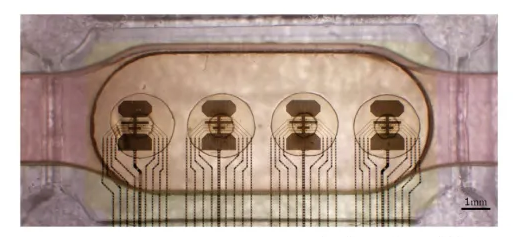
The third frontier abandons silicon. Human stem cells are coaxed into brain organoids — spheroids of neurons and supporting cells a few hundred micrometres across — which are then placed on a multi-electrode array, a chip whose electrodes both record spikes and deliver stimulation. Nutrient medium flows underneath continuously; cameras and environmental sensors watch for trouble. Experiments are scripted in Python and run remotely.
- Organoids survive on the array for weeks to months, against hours in early attempts.
- One platform has run over a thousand organoids and accumulated more than 18 terabytes of recordings.
- Reward is delivered chemically: dopamine is released from a light-sensitive molecular cage by a pulse of ultraviolet light.
- Access is remote and shared, so groups without a wet lab can run electrophysiology.
The reason anyone bothers is the same reason this page keeps returning to: a human brain runs on roughly twenty watts. But the honest summary of what these systems have computed is thin. The best-known result had a culture of cortical cells improve at a simulated game of Pong, and even the researchers building the platforms have publicly warned that terms like "organoid intelligence" are running well ahead of the evidence. Firing patterns drift day to day, so a training procedure that worked yesterday may not transfer.
What these three trends share, and where they split
All three fit a model to one particular nervous system — this participant's cortex, this patient's connectome, this organoid's drifting dynamics. Cognitive science spent decades averaging across subjects to find general laws. The instruments now support the opposite move, and personalisation turns out to be where the clinical value is.
Speech decoding and brain twins have measurable endpoints — words per minute, surgical outcome — and are improving against them. Wetware computing has no comparable benchmark it is beating. That difference should change how much weight you give each one, regardless of how similar the press coverage sounds.
How Technological Innovation Reshapes Cognitive Systems
Hardware decides which algorithms are practical, and the algorithms that are practical decide which theories of cognition get tested. The current constraint is energy, and the current response is to stop computing things that have not changed.
Neuromorphic hardware reaches billion-neuron scale
A conventional neural network evaluates every unit on every pass, in lockstep, and shuttles weights back and forth from memory. Neuromorphic hardware does neither. Units are spiking — they stay silent until an accumulated charge crosses a threshold, then emit a one-bit pulse — memory sits next to compute, and nothing happens where nothing has changed.
| System | Scale | Reported advantage | Status |
|---|---|---|---|
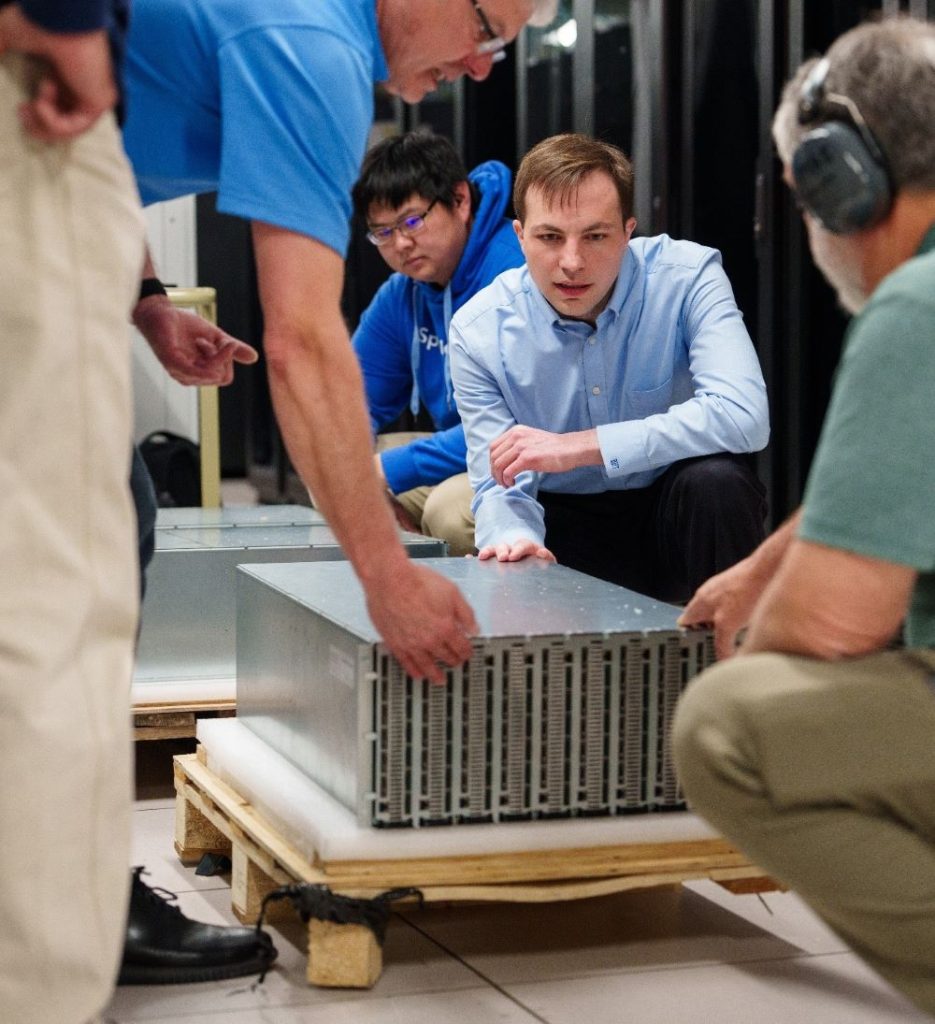
| Hala Point | 1,152 Loihi 2 chips, 1.15 billion neurons, 128 billion synapses, about 2,600 W | Orders-of-magnitude energy savings on sparse, event-driven workloads | Research system |
| IBM NorthPole | A mesh of compute units holding all weights on-chip | Roughly 22× the energy efficiency of leading GPUs on image-recognition inference | Research chip |
| SpiNNaker2 | Roughly five million general-purpose ARM cores in a brain-inspired routing topology | Flexibility — arbitrary neuron models, since the cores are programmable | Deployed at research labs |
Why the savings are conditional
Event-driven efficiency is only realised when the input is genuinely sparse in time — continuous audio, event cameras that report changed pixels instead of whole frames, robot control loops. Dense matrix multiplication, which is what today's large language models are, maps poorly onto this hardware. None of these systems has shipped as a commercial product; deployments are research partnerships, and the binding constraint is software rather than silicon.
The arithmetic behind the claim is simple enough to check. If a layer fans out to a fixed number of downstream units, a dense pass costs one operation per unit per step regardless of activity, while an event-driven pass costs one only per spike. Sparsity is the whole story.
import numpy as np
rng = np.random.default_rng(0)

def cost(spikes, fanout=128):
    dense = spikes.size * fanout
    event = int(spikes.sum()) * fanout
    return dense, event

for rate in (0.5, 0.05, 0.005):
    spikes = rng.random((1000, 256)) < rate
    dense, event = cost(spikes)
    print(f'rate {rate:<6} dense {dense:>9} event {event:>8} saving {dense / max(event, 1):.0f}x')
The memory problem in artificial agents
The other innovation reshaping cognitive systems is not hardware at all. A transformer-based model stores what it knows in fixed weights, set during training and frozen afterwards. Training on something new disturbs what was already there — catastrophic forgetting — so deployed systems do not learn from the work they do. Everything they retain across sessions has to be written down outside the model and fed back in.
External memory
Store past episodes in a database and retrieve the relevant ones. It works, and it is exactly how it sounds: a filing cabinet bolted to a system that cannot remember. Retrieval quality becomes the bottleneck.
Continual learning
Update weights as experience arrives without wrecking earlier skills, using rehearsal of stored samples, constraints on which weights may move, or separate fast and slow components — a split with an obvious biological parallel.
World models
Learn a simulator of the environment, then plan by rolling it forward instead of acting to find out. This is the machine-learning form of the claim that cortex is fundamentally a prediction engine.
None of the three is solved, and the framing matters more than the leaderboard: all of them are attempts to give an artificial system the two properties biological cognition has by default — memory that accumulates and a model of the world that supports imagining an action before taking it. Notice that reinforcement learning already borrowed the first of these from the hippocampus in the form of replay buffers; the borrowing is not finished.
Where hardware and cognition meet, and where they don't
Sparse activity, event-driven updates, local computation, and consolidating experience during downtime are all principles brains arrived at under a strict energy budget. Engineering is adopting them now for the same reason — the electricity bill — rather than out of any commitment to biological realism.
A brain does not need a compiler, a benchmark suite, or a hiring pool. Neuromorphic hardware has been technically impressive and commercially marginal for over a decade, because the surrounding tooling — not the transistor count — is what decides whether an architecture gets used.
Evaluating Future Directions
Forecasting badly is easy: pick the most exciting demonstration and extend the line. Forecasting usefully means separating three questions that get conflated — is the underlying claim supported, is anyone using it for real work, and what observation would show it is going nowhere. A direction with no answer to the third question is not a research programme.
| Direction | Evidence today | Real use | What would falsify it |
|---|---|---|---|
| Speech BCIs | Strong — multiple participants, published error rates, sustained home use | Clinical trials | Electrode signals degrading faster than decoders can be recalibrated |
| Virtual brain twins | Moderate — trialled in epilepsy; degeneracy of fits remains unresolved | Surgical planning | Predictions failing to beat existing clinical judgement on outcomes |
| Neuromorphic computing | Strong on energy for sparse workloads; weak on general workloads | Research partnerships | Conventional accelerators closing the efficiency gap through sparsity support |
| Wetware computing | Weak — activity is measurable, computation is barely demonstrated | Exploratory | No task where an organoid beats a cheap microcontroller on any axis |
| Continual learning | Moderate — many methods, no standard that survives contact with deployment | Agent frameworks | Retrieval over an external store proving good enough that weight updates stay unnecessary |
Energy is the organising constraint
A human brain, running continuously, learning as it goes
Hala Point at peak — efficient by machine standards, still a hundredfold gap
Scale at which frontier model training is measured, before inference is counted
Read the whole page through this number and the trends line up. Neuromorphic chips, organoid processors, sparse routing, and on-device inference are four different attacks on one gap. Whether the gap is closable by better engineering or reflects something specific to biological substrate is, at present, genuinely unknown — which is precisely why the substrate experiments are worth running even though their computational results are unimpressive.
Reading claims in a field with money in it
Ask what the baseline was
"A thousand times more efficient" is a comparison, and the comparison is usually against a general-purpose processor running a workload it was never suited to. Efficiency claims for specialised hardware are true and narrow at the same time.
Ask who is warning you
When the researchers closest to a technology publicly worry that the marketing language will trigger a backlash — as organoid biologists have about "organoid intelligence" — that is unusually good evidence about where the work actually stands.
What the next decade is likely to settle
Neuroscience supplies AI with mechanisms and data; AI supplies neuroscience with models precise enough to fail informatively and decoders good enough to be clinically useful. Speech interfaces are the clearest case — a neuroscience result that only works because of machine learning, and a machine learning system whose training data is cortex.
Every trend here improves what can be built or measured. None of them explains why any of it produces a mind. Better decoders read intention without accounting for intention, and a personalised simulation predicts a seizure without saying what it is like to have one. Expect the engineering gap to keep closing and the explanatory one to stay open.
Tools & Tutorials
- Lava — end-to-end neuromorphic tutorial — build and run a spiking classifier in the open-source framework that targets Loihi 2, starting from processes and connections rather than layers, with a simulation backend so no special hardware is needed.
- FinalSpark live organoid feed — a continuously updating view of electrical activity recorded from human brain organoids sitting on multi-electrode arrays; useful for seeing how irregular real spontaneous activity looks.
- Brain-Score — an interactive leaderboard scoring vision models on how well their internal representations predict recorded neural activity and primate behaviour, with the benchmarks and submission pipeline open.
- The Virtual Brain on EBRAINS — the simulator behind virtual brain twins, with hosted notebooks for building a whole-brain network model from a connectome and comparing simulated to recorded dynamics.
- Open Neuromorphic — a community-maintained guide to hardware, software frameworks, and datasets in the field, including talk recordings and a comparison of the available chips.
Further reading
- Kudithipudi, D., Schuman, C., Vineyard, C. M., et al. (2025). Neuromorphic Computing at Scale. Nature, 637, 801–812. — a twenty-three-author roadmap covering what scaling actually requires: architecture, benchmarks, tooling, and the ecosystem gaps that have held the field back.
- Wang, H. E., Triebkorn, P., Breyton, M., et al. (2024). Virtual Brain Twins: From Basic Neuroscience to Clinical Use. National Science Review, 11(5). — the standard reference on personalisation, model inversion, and applications across epilepsy, Alzheimer's, Parkinson's, multiple sclerosis, and psychiatry.
- Kunz, E. M., Abramovich Krasa, B., Kamdar, F., et al. (2025). Inner Speech in Motor Cortex and Implications for Speech Neuroprostheses. Cell, 188(17). — shows imagined sentences are decodable in real time across four participants, and proposes a keyword-gated safeguard for mental privacy.
- Card, N. S., Singer-Clark, T., Peracha, H., et al. (2026). Long-Term Independent Use of an Intracortical Brain–Computer Interface. Nature Medicine, 32, 2504–2510. — nearly two years of unsupervised at-home speech and cursor control, and the clearest account of what stability rather than peak accuracy demands.
- Smirnova, L., Caffo, B. S., Gracias, D. H., et al. (2023). Organoid Intelligence: The New Frontier in Biocomputing. Frontiers in Science, 1:1017235. — the agenda-setting paper for wetware computing, including the ethical framework its authors argue has to be built alongside the technology.
- Molteni, M. (2025). Brain Organoid Pioneers Fear Inflated Claims About Biocomputing Could Backfire. STAT. — reporting from a field meeting where the researchers themselves push back on the marketing vocabulary; a useful calibration against every other source on this topic.