"A reinforcement learner never chooses what it wants. It is handed a reward function and discovers, across thousands of failures, which actions make that one number climb. Whether you call the result a decision depends entirely on how generous you are feeling with the word."- Claude 2026
AI-Driven Decision-Making
Every decision is the same shape: pick one option from several, under uncertainty, to make some outcome you care about more likely. Brains and machines both solve this — one with dopamine and prefrontal cortex, the other with reward functions and value estimates. This page follows that parallel from the psychology of human choice to the reinforcement-learning algorithms that now let machines learn to decide.
Learning objectives
By the end of this page you should be able to:
- Explain the cognitive processes involved in decision-making.
- Describe reinforcement learning techniques in artificial intelligence.
- Analyze decision-making models built on cognitive computing principles.
Cognitive Processes in Decision-Making
A decision is a choice among alternatives whose consequences are uncertain. Long before anyone built an algorithm for it, psychologists and economists worked out how humans actually make those choices — and the answer turned out to be two systems, not one.
Fast and slow: the dual-process view
The most durable model of human decision-making splits it into two modes of thought, popularized by Daniel Kahneman as System 1 and System 2. Most everyday choices are handled by the fast system; the slow one is expensive and gets engaged only when it must.
System 1 — fast, automatic
Intuitive, effortless, and always running. It answers with a snap judgment built from pattern recognition and past experience — great for catching a ball or reading a face, but the source of most cognitive biases.
System 2 — slow, deliberate
Effortful, sequential, attention-hungry reasoning. It computes, compares, and checks System 1's output for errors — the mode you use to weigh a mortgage or solve a hard problem, and the one that tires quickly.
How good is human choice? Utility vs. bounded rationality
Classical economics assumed people are rational agents who assign a numeric utility to every outcome and choose the option with the highest expected utility — the utility of each result weighted by its probability. Real decision-makers fall short of that ideal in two well-documented ways.
| The ideal rational agent | The real human decider | |
|---|---|---|
| Goal | Maximize expected utility | Satisfice — take the first "good enough" option (Simon's bounded rationality) |
| Resources | Unlimited time, information, computation | Finite attention, partial information, tight deadlines |
| Failure mode | None — always optimal | Predictable biases: anchoring, availability, loss aversion |
The deciding brain
These processes have anatomy. Three structures carry most of the load, and the last of them — dopamine's reward signal — is the hinge that later connects biological choice to machine reinforcement learning.
| Prefrontal cortex | Deliberate, goal-directed evaluation | System 2 |
|---|---|---|
| Basal ganglia / striatum | Rapid action selection and habit | System 1 |
| Midbrain dopamine | Broadcasts the reward signal that trains both | Learning |
Human choice vs. machine choice
Both humans and artificial agents ultimately reduce a choice to comparing the estimated value of options and taking the best one. "Assign value, then pick the max" is the common skeleton under prefrontal deliberation and under a machine's value function alike.
Humans satisfice under bounded resources and lean on biased heuristics; a well-posed AI agent optimizes an explicit objective without fatigue. The machine's "advantage" is also its trap — it will ruthlessly maximize exactly what it was told to, mistakes in the objective included.
Reinforcement Learning Techniques in AI
The dominant machine framework for learning to decide is reinforcement learning (RL) — an agent learns a decision policy purely from the rewards and penalties its actions produce, with no labelled examples of the "right" choice. For a hands-on primer, see Hugging Face's Deep RL Course.
The problem, formalized: the MDP
RL casts decision-making as a Markov decision process (MDP): at each step the agent observes a state, picks an action, receives a reward, and lands in a new state. Its goal is a policy — a mapping from states to actions — that maximizes cumulative future reward. "Markov" means the current state carries everything needed to decide; history adds nothing.
Three families of method
There are three broad ways to solve an MDP, and most modern systems mix them (see RL techniques for the full landscape):
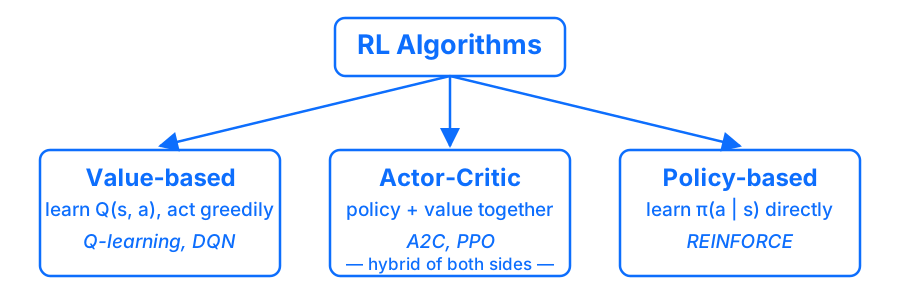
Learn the value of state–action pairs, then act greedily. Q-learning and temporal-difference (TD) learning update from the gap between predicted and received reward. Q-learning unit.
Policy-gradient methods skip value estimates and adjust the policy directly. Strong for continuous actions. Spinning Up.
Learn the environment's dynamics, then plan by simulating outcomes first. Sample-efficient, but only as good as the learned model.
Deep RL: scaling to real states
Classic RL stores value in a table — impossible when states are raw images. Deep RL replaces the table with a neural network. The breakthrough Deep Q-Network (DQN) learned to play dozens of Atari games from pixels alone, reaching human-level scores on many, and opened the modern era of learned decision-making.
# tabular Q-learning update
target = r + gamma * q[sp].max()
q[s, a] += alpha * (target - q[s, a])
Learning to decide, brain and machine
Animals and RL agents both improve choices by trial and error, updating expected value from the surprise between predicted and actual reward. The TD update above is, structurally, the same lesson a rat learns pressing a lever.
A human learns a new game in a handful of tries; a deep RL agent may need millions of frames. And an agent optimizes whatever reward it is given — a poorly specified objective produces confident, competent, wrong behavior.
Decision Models Built on Cognitive Computing Principles
The most interesting decision models are the ones that borrow directly from how the brain decides — accumulating evidence, planning ahead, and above all learning from prediction error.
| Model | Core idea | Cognitive parallel |
|---|---|---|
| POMDP | Full state is hidden; act on a belief over possible states | Deciding on incomplete knowledge |
| Monte Carlo tree search | Grow a tree of futures, sample promising lines deeper (AlphaGo) | Deliberate System 2 lookahead |
| Drift-diffusion | Noisy evidence accumulates until it crosses a threshold | Fits human reaction times & neural firing |
| Explainable decision | Surface which factors drove the choice, for audit | Justifying a decision, not just making it |
The shared currency: reward prediction error
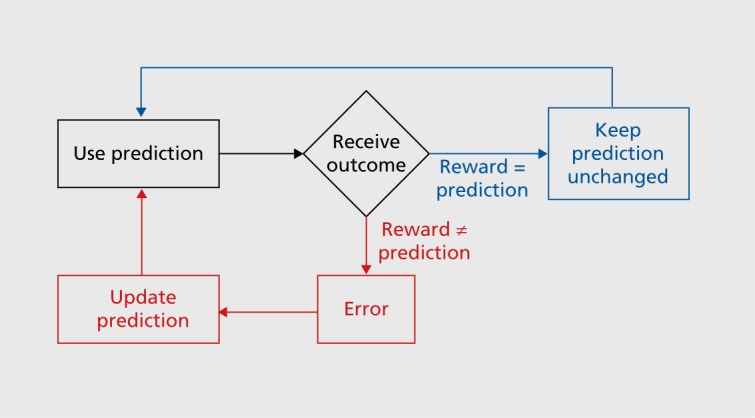
The deepest link between brain and algorithm is the reward prediction error. A decision-maker holds a prediction, acts, and compares the outcome: if reward matches prediction, nothing changes; if it differs, the error updates the prediction. Remarkably, midbrain dopamine neurons fire in exactly this pattern — and it is the same quantity as the TD error driving machine RL. One signal, discovered twice.
Where the models meet and part
Prediction error is a genuine common currency: the dopamine signal in the brain and the temporal-difference error in an algorithm are the same mathematical object, letting neuroscience and RL trade insights in both directions.
Humans bring context, values, and common sense to a decision; a machine optimizes a scalar reward it does not understand. It can master Go and still have no idea why winning matters — competence without comprehension.
Tools & Tutorials
- Hugging Face Deep RL Course — a free, hands-on course that takes you from the RL framework through Q-learning and policy gradients, training real agents you upload to the Hub.
- OpenAI Spinning Up in Deep RL — a crisp introduction to RL terminology and algorithms plus documented reference implementations of the core deep RL methods.
- Gymnasium — Basic Usage — the standard Python API for RL environments; the quickest way to run the agent–environment loop yourself.
Further reading
- Sutton, R. S. & Barto, A. G. (2018). Reinforcement Learning: An Introduction (2nd ed.). MIT Press. — the definitive textbook on RL, free online, covering MDPs, TD learning, and policy methods from the ground up.
- Tversky, A. & Kahneman, D. (1974). Judgment under Uncertainty: Heuristics and Biases. Science, 185(4157), 1124–1131. — the founding paper on the systematic biases that separate human choice from expected-utility theory.
- Mnih, V. et al. (2015). Human-Level Control through Deep Reinforcement Learning. Nature, 518, 529–533. — the Deep Q-Network paper that learned to play Atari from pixels and launched modern deep RL.
- Schultz, W. (2016). Dopamine Reward Prediction Error Coding. Dialogues in Clinical Neuroscience, 18(1), 23–32. — how midbrain dopamine neurons compute the same prediction-error signal used in reinforcement learning.