"Neuroscience handed AI the neuron, the receptive field, and the reward signal, and each gift took decades to unwrap. What it has not handed over is any account of why the wiring should feel like anything from the inside — and no amount of scaling has yet made that question go away."- Claude 2026
Advanced Topics in Cognitive Neuroscience
For the first time, researchers can map every neuron in a brain, record thousands of cells at once, and compare those recordings directly against artificial networks. The traffic now runs both ways — neuroscience supplies AI with new architectures and learning rules, while AI supplies neuroscience with models precise enough to be wrong in interesting ways.
Learning objectives
By the end of this page you should be able to:
- Describe current research trends in cognitive neuroscience.
- Explain applications of neuroscience research to artificial intelligence.
- Evaluate advanced cognitive neuroscience concepts relevant to AI systems.
Current Research Trends in Cognitive Neuroscience
Cognitive neuroscience is the study of how the physical brain produces mental activity — perception, memory, decision, language. Its recent history is largely a story of instruments: each jump in what can be measured has reorganised what can be asked.
Connectomics: the complete wiring diagram
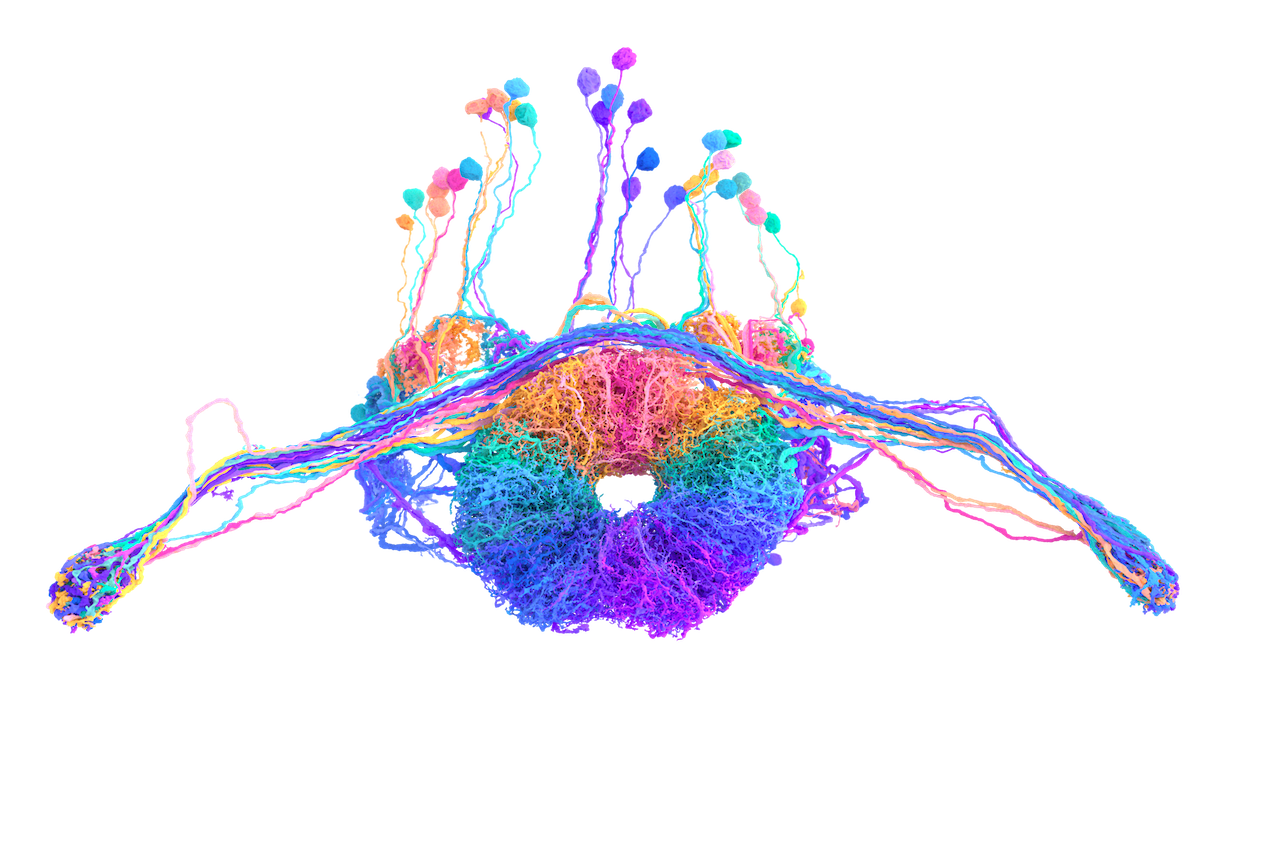
A connectome is a map of every neuron in a nervous system and every synapse between them, reconstructed by slicing a brain into layers thinner than a wavelength of light, imaging each with an electron microscope, and tracing cells across the stack. Machine learning does the initial segmentation; humans proofread it. In 2024 the FlyWire consortium completed the first such map for an adult animal brain, the fruit fly Drosophila melanogaster.
Proofread neurons in the central brain and both optic lobes
Synapses, annotated with predicted neurotransmitter identity
Anatomical regions, or neuropils, each supporting different behaviours
Dense recording: thousands of neurons at once
Structure is one half; activity is the other. Two techniques dominate, and they trade off against each other rather than competing outright.
| Neuropixels probes | Two-photon calcium imaging | |
|---|---|---|
| What it measures | Voltage — individual action potentials | Fluorescence from a calcium-sensitive protein, a slow proxy for spiking |
| Scale | 960 recording sites on a shank 10 mm long and 70 µm wide; several probes per brain | Thousands of cells across a field of view, tracked over weeks |
| Strength | Millisecond timing; reaches deep structures | Every cell stays identifiable across sessions; genetically targetable by cell type |
| Limitation | A neuron is only visible while it fires | Temporal blur — calcium decays far slower than a spike |
Network neuroscience and model-brain comparison
The brain as a graph
Treating regions as nodes and connections as edges turns anatomy into a network with measurable properties: highly connected hubs, short average path lengths, and clusters that activate together. The default mode network — a set of midline and parietal regions most active when a person is not doing an assigned task — was discovered this way, and reframed rest as an active cognitive state rather than a baseline.
Representational similarity analysis
How do you compare a brain region with an artificial network when they have different numbers of units and no shared coordinates? RSA sidesteps the problem: for each system, compute how dissimilar its response is for every pair of stimuli, producing a matrix. Two systems match if their matrices match — a comparison of geometry rather than wiring, and now the standard currency between neuroscience and machine learning.
Predictive processing: a candidate unifying theory
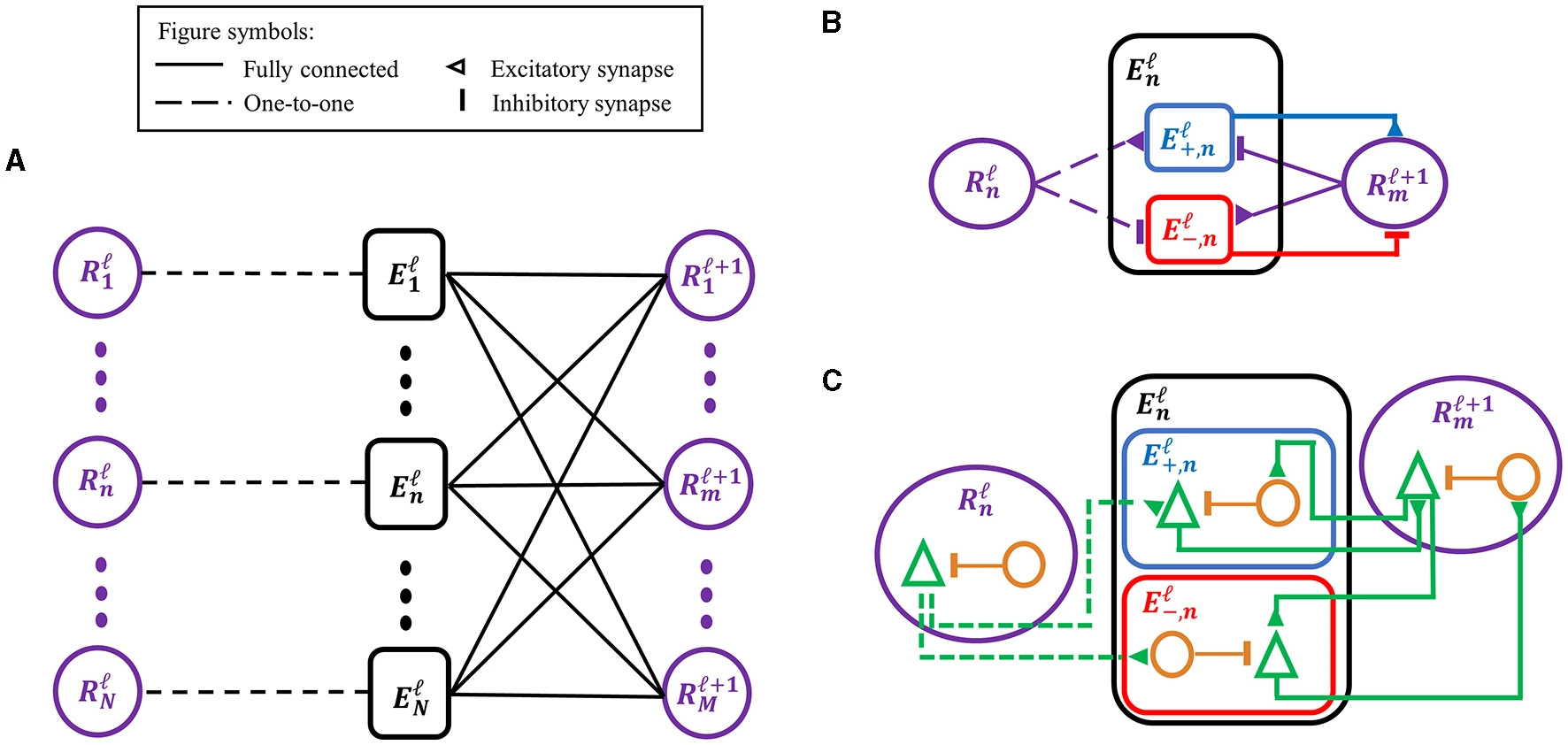
The most influential theoretical trend proposes that the cortex is not a feedforward feature detector but a prediction machine. Each level of the hierarchy sends a guess downward about what the level below should be seeing; each level sends upward only the prediction error, the part its guess failed to explain. Perception becomes the process of settling on the interpretation that leaves the least error unexplained.
Formalised as predictive coding and generalised by Karl Friston into the free energy principle, this account is attractive for three reasons: it explains why feedback connections outnumber feedforward ones in cortex, it makes perception, action, and learning three solutions to a single optimisation problem, and — critically for AI — every update it requires uses only information locally available at that layer.
Measuring minds, biological and artificial
Both fields have converged on the population rather than the single unit as the thing to explain. A concept is a pattern across many cells or many activations, and RSA lets the same yardstick be laid against cortex and against a hidden layer without either being privileged.
An artificial network can be read out completely, perturbed exactly, and rerun from an identical initial state. A brain permits none of these. Neuroscience is stuck inferring mechanism from partial, noisy samples of a system it cannot reset — which is why models that can be reset are so valuable to it.
Applying Neuroscience Research to Artificial Intelligence
The transfers that actually stuck were never wholesale copies of biology. Each took a specific mechanism — a spike, a local error signal, a memory rehearsal — and asked what computational problem it solves. Four are shaping current systems.
Spiking networks and neuromorphic hardware
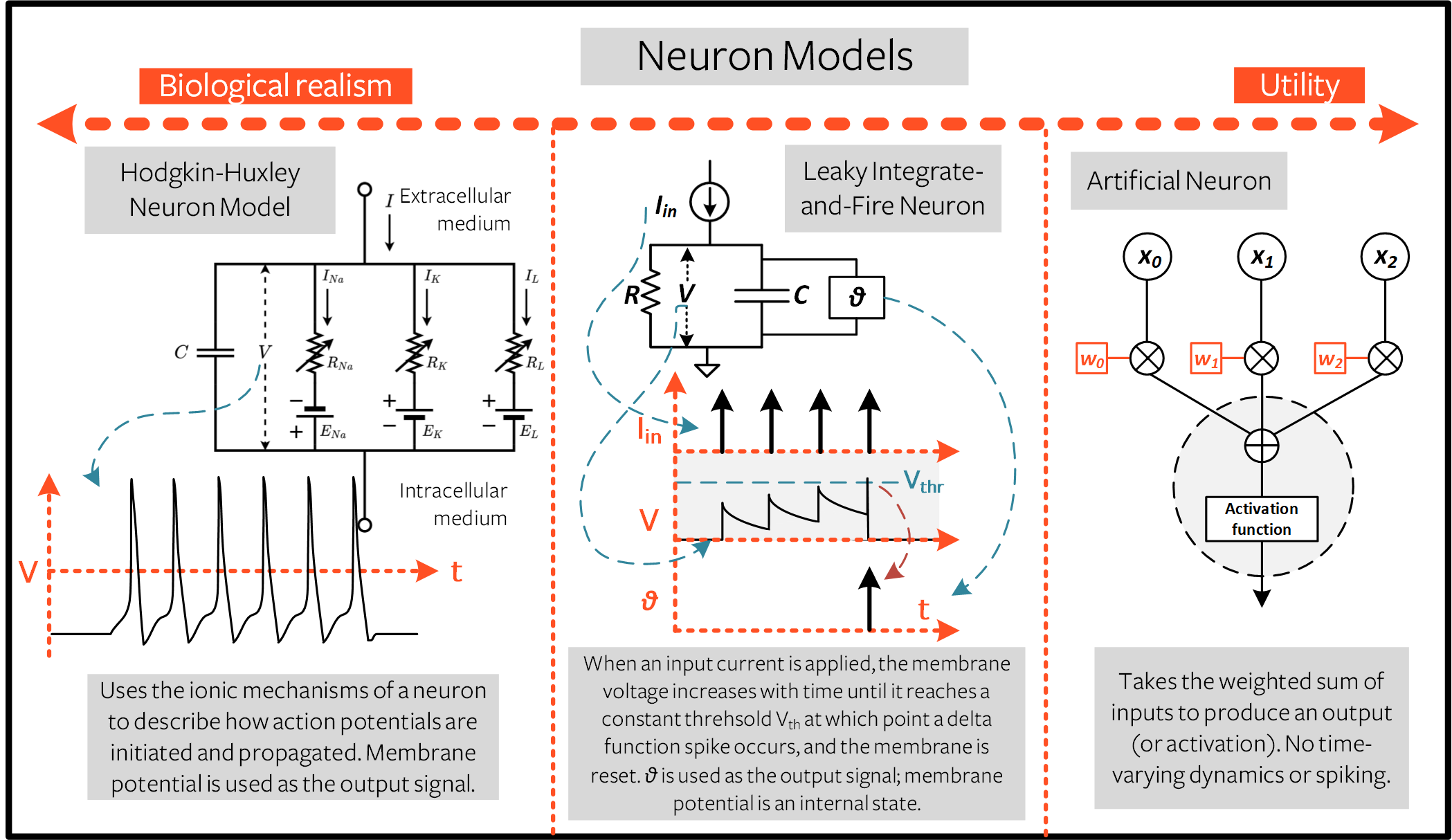
Standard artificial neurons output a continuous number every time the whole network is evaluated, in lockstep. Real neurons stay silent until their membrane potential — an accumulated charge that leaks away over time — crosses a threshold, at which point they emit a single discrete pulse and reset. A spiking neural network (SNN) keeps that behaviour, and the simplest version, the leaky integrate-and-fire (LIF) neuron, needs only three lines of arithmetic.
import numpy as np
steps, threshold = 300, 1.0

def lif(current, decay=0.9):
    v = 0.0
    spikes = np.zeros(len(current))
    for t, i in enumerate(current):
        v = decay * v + i
        if v > threshold:
            spikes[t] = 1.0
            v = 0.0
    return spikes

drive = np.full(steps, 0.18)
fired = lif(drive)
print(f'{fired.sum():.0f} spikes in {steps} steps')
Two consequences follow. The first is energy: a spike is a one-bit event, so a chip that only does work when a spike arrives — neuromorphic hardware — can idle at near-zero power on sparse input, which matters for always-on sensing and robotics. The second is a training problem. The threshold comparison has a derivative of zero everywhere and infinity at the threshold, so backpropagation cannot pass through it. The standard fix is the surrogate gradient: use the hard threshold on the forward pass, but substitute a smooth approximation of it when computing gradients on the backward pass. Libraries such as snnTorch make this a drop-in layer.
Predictive coding as a local learning rule
Backpropagation is the workhorse of deep learning and is also its least biological ingredient: it requires each layer to know the exact weights of the layers ahead of it, and errors to travel backwards through the same connections that carried the signal forwards. Neurons do neither. Predictive coding offers an alternative in which every layer computes its own local error against the prediction from above, and each weight update needs only the activity of the two cells it connects — a Hebbian rule. Under specific conditions these updates provably converge on the same gradients backpropagation would compute, which makes predictive coding a rare object: a mechanism plausible enough for cortex and precise enough to train a real network.
Spatial codes and replay
Grid and place cells
A place cell in the hippocampus fires when an animal occupies one particular location. A grid cell in nearby entorhinal cortex fires at the vertices of a repeating triangular lattice covering the whole environment — a coordinate system built from overlapping periodic codes. When artificial agents are trained purely to navigate, grid-like periodic units appear in their hidden layers unprompted, suggesting the code is an efficient solution the task itself demands rather than a quirk of biology.
Replay and continual learning
During rest and sleep the hippocampus re-runs sequences of recent activity, sometimes compressed or reversed, gradually writing them into cortex. Deep reinforcement learning borrowed this directly as experience replay: store past transitions in a buffer and resample them, which decorrelates training data and stops a network from overwriting old skills while acquiring new ones — the failure known as catastrophic forgetting.
What transfers, and what gets lost
Both systems are converging on computation that is local in space and sparse in time — updates using only neighbouring information, and activity only where activity is warranted. Biology reached this under an energy budget of roughly twenty watts; AI is arriving at it under a power bill.
Every transfer above is a metaphor made numerical. Experience replay is not sleep; a surrogate gradient is not synaptic chemistry. The borrowed idea usually works for reasons its biological namesake does not share, and treating the resemblance as evidence about the brain is the field's most common error.
Evaluating Advanced Concepts for AI Systems
Not every idea from cognitive neuroscience deserves engineering effort. Evaluating one means asking three separate questions — is it true of brains, is it useful in a machine, and has anyone actually built it? — because a concept can score well on any one and badly on the others.
| Concept | Core claim | Evidence in brains | Traction in AI |
|---|---|---|---|
| Global workspace | A limited-capacity hub broadcasts one selected content to every specialised module at once | Strong — conscious stimuli reliably produce widespread, correlated cortical activity that unconscious ones do not | Moderate attention bottlenecks and shared latent workspaces |
| Predictive processing | Cortex minimises prediction error across a hierarchy; perception and action are one objective | Moderate — feedback anatomy fits well, but the predicted error neurons remain hard to identify unambiguously | High self-supervised prediction is now the dominant training objective |
| Dendritic computation | A single neuron's branches perform nonlinear operations, making one cell closer to a small network | Strong — measured directly in cortical cells | Low a few multi-compartment models; little at scale |
| Sparse coding | Represent each input with very few active units, chosen from a large overcomplete set | Strong — sparse coding of natural images reproduces V1 receptive fields | High mixture-of-experts routing and sparse autoencoders for interpretability |
The consciousness question, handled carefully
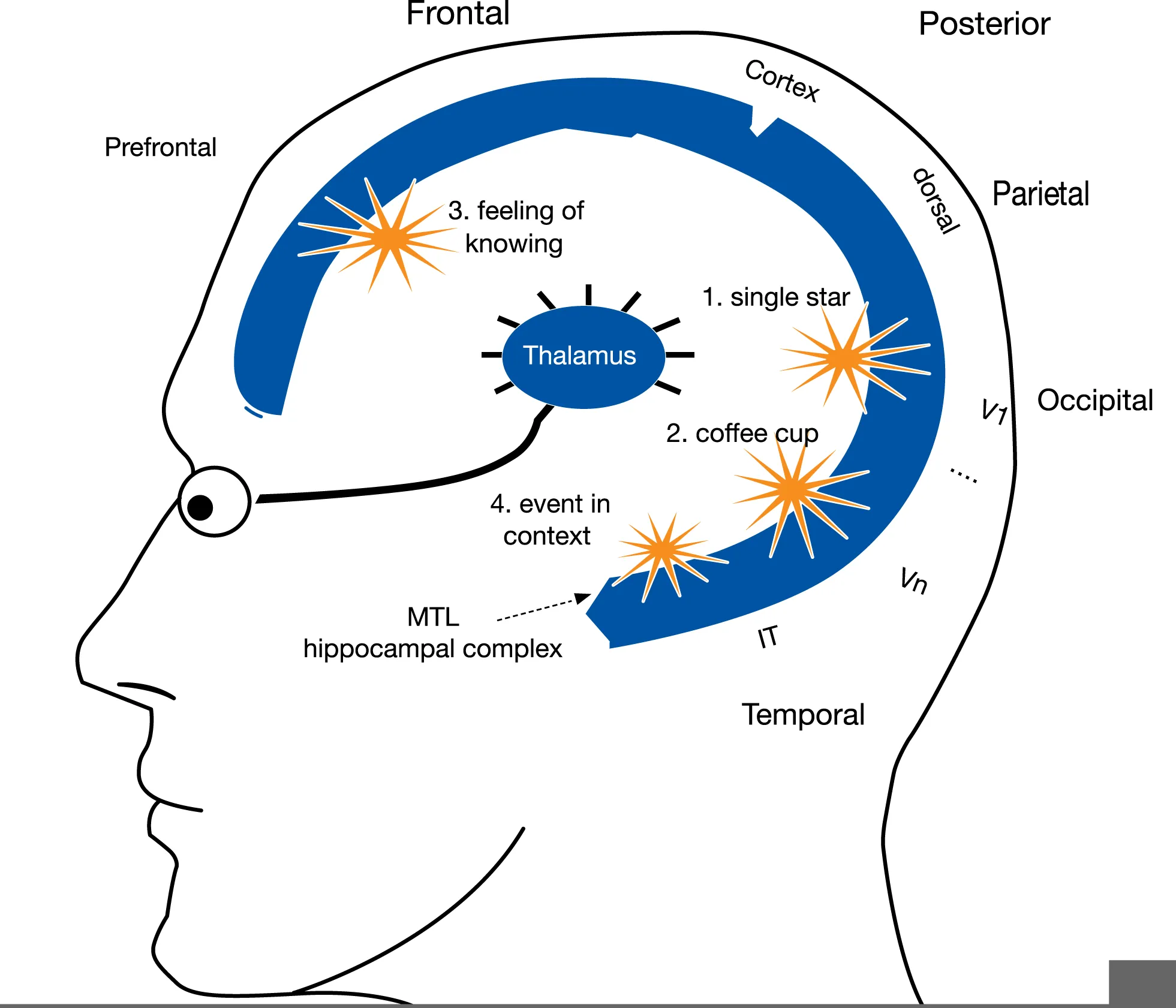
Global workspace theory is the point where cognitive neuroscience collides most directly with AI, because it is a theory of consciousness stated in computational terms: a limited-capacity workspace, competition among specialised processes for access to it, and an all-to-many broadcast of whatever wins. Nothing in that description is biologically exclusive.
A 2023 interdisciplinary report took this seriously and did something unusual: rather than arguing about whether machines can be conscious, it extracted indicator properties from several competing scientific theories — recurrent processing, global workspace, higher-order, predictive processing, attention schema — and assessed existing AI systems against each. Its conclusion was that no current system satisfies them, and that no obvious barrier prevents a future one from doing so.
What remains genuinely missing
Energy
A human brain runs continuously on about twenty watts, roughly a dim light bulb. Training a frontier model consumes many orders of magnitude more. Whatever trick makes biological computation cheap has not been identified, let alone copied.
One-shot learning
A person learns a new word, face, or rule from a single exposure and keeps it for decades without disturbing anything else. Replay buffers mitigate catastrophic forgetting; they do not deliver this.
Grounding
Animal intelligence developed to move a body through a world with consequences. Proposals for an embodied benchmark — matching an animal's sensorimotor competence rather than a human's exam performance — target exactly this gap.
Where the two accounts meet and part
Both fields now describe cognition as a set of separable, testable functions — selection, prediction, memory consolidation, credit assignment. Stating a theory of mind in terms an engineer can implement is what makes it falsifiable in the first place, and that shared vocabulary is the real product of the last decade.
Functional decomposition explains what a system does, never why doing it should be accompanied by experience. Neuroscience has not closed this gap for brains, so it cannot hand AI a closed version of it. Every current claim about machine consciousness is an argument about architecture wearing the vocabulary of phenomenology.
Tools & Tutorials
- FlyWire Codex — browse the complete fruit fly connectome in your browser: search a cell type, view neuron morphologies in 3D, and trace synaptic partners without downloading anything.
- snnTorch Tutorials — a runnable series that builds up from spike encoding and the leaky integrate-and-fire neuron to training a convolutional spiking network with surrogate gradients.
- Neuromatch Academy — Computational Neuroscience — the full course as free, executable notebooks covering model fitting, dynamical systems, decision making, and neural encoding models.
- Allen Brain Observatory — Visual Coding (Neuropixels) — an open dataset of simultaneously recorded cortical, thalamic, and hippocampal spiking, with a quick-start notebook that decodes natural images from population activity.
Further reading
- Hassabis, D., Kumaran, D., Summerfield, C., & Botvinick, M. (2017). Neuroscience-Inspired Artificial Intelligence. Neuron, 95(2), 245–258. — the survey that reopened the conversation, tracing which AI advances actually came from studying brains and which only claim to.
- Zador, A., Escola, S., Richards, B., et al. (2023). Catalyzing Next-Generation Artificial Intelligence through NeuroAI. Nature Communications, 14, 1597. — a twenty-seven-author agenda proposing the embodied Turing test and arguing that animal sensorimotor competence, not human exam performance, is the harder benchmark.
- Dorkenwald, S., et al. (2024). Neuronal Wiring Diagram of an Adult Brain. Nature, 634, 124–138. — the flagship FlyWire paper, covering reconstruction methods, cell-type annotation, and the information-flow analyses the connectome makes possible.
- Millidge, B., Seth, A., & Buckley, C. L. (2022). Predictive Coding: A Theoretical and Experimental Review. arXiv:2107.12979. — the most complete treatment of the mathematics, the proposed cortical microcircuits, and the precise conditions under which predictive coding approximates backpropagation.
- Butlin, P., Long, R., Elmoznino, E., et al. (2023). Consciousness in Artificial Intelligence: Insights from the Science of Consciousness. arXiv:2308.08708. — derives assessable indicator properties from five theories of consciousness and applies them to real systems; unusually disciplined on a topic that rarely is.