What Does "Safe" Mean?
A system is safe when the risk of it causing harm to people, property, or the environment is acceptably low. Safety is not the same as reliability: a system can work exactly as designed every time and still be unsafe, if the design itself is wrong.
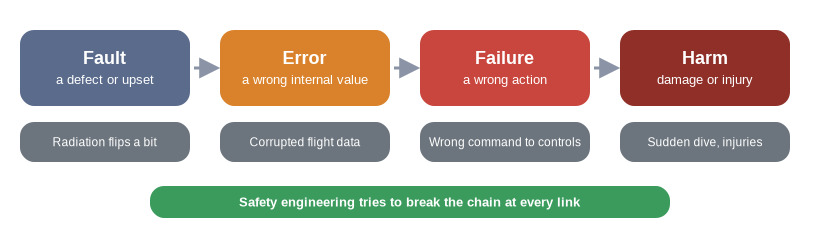
Harm rarely appears out of nowhere. It usually follows a chain of events, and every link is a chance to stop it.
Safety in the News

Sun radiation versus flight software
After a JetBlue jet suddenly pitched down and passengers were injured, Airbus found that intense solar radiation could corrupt flight-control data. About 6,000 A320-family planes needed a software fix.
Tom's Hardware, November 2025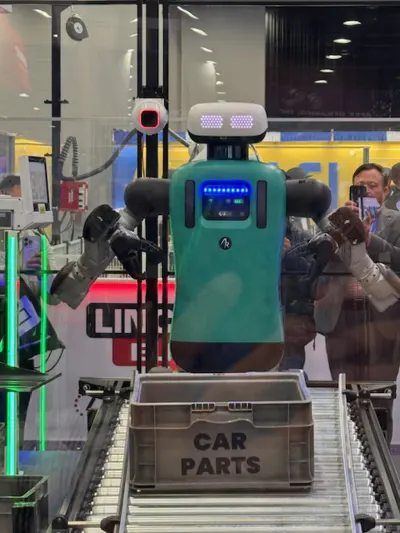
Can humanoid robots work beside people?
Agility Robotics says no humanoid is yet safe to share tasks directly with people. A new standard for robots that balance on their own, ISO 25785-1, is being written to help.
Tech Briefs, May 2025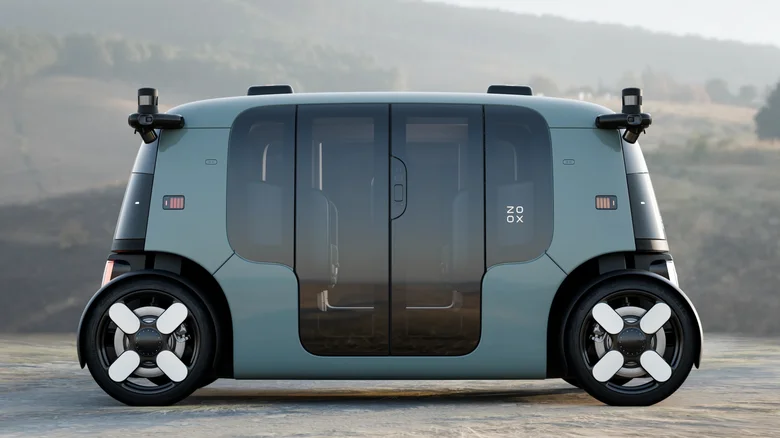
A robotaxi meets smoke
Zoox recalled software on 105 robotaxis after one drove into heavy smoke at a fire scene. Nothing was broken. The system simply misjudged a situation it was not designed for.
Engadget, July 2026Finding Hazards Before They Happen
Safety engineers search for problems on paper long before a system is built. A few widely used methods:
FMEA: "What if this part fails?"
Failure Mode and Effects Analysis goes part by part, asks how each one could fail, and traces what would happen next.
Fault tree: "What could cause this disaster?"
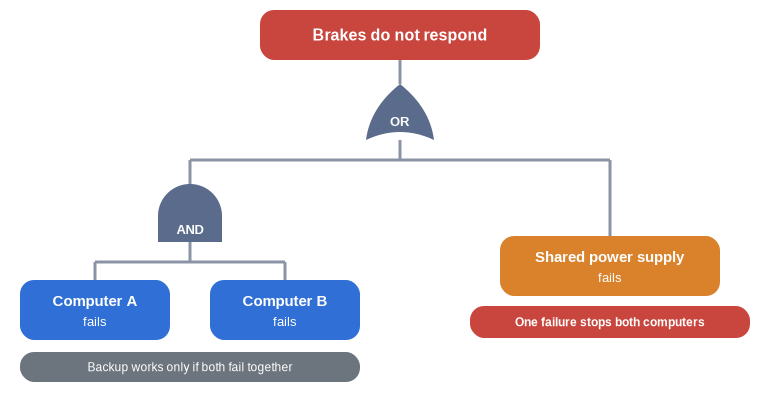
Fault Tree Analysis starts from the worst outcome and works backward to every combination of failures that could cause it.
STPA: "What if the control loop goes wrong?"
System-Theoretic Process Analysis, developed at MIT, looks for unsafe commands and misunderstandings even when no part is broken, like the robotaxi in smoke.
HAZOP: "What if things deviate?"
Hazard and Operability studies use team brainstorming with guide words like "more," "less," and "reverse," and are common in chemical plants.
Surviving Failures with Redundancy
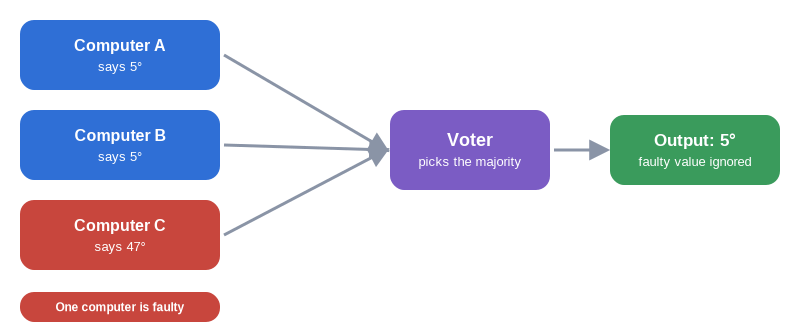
Redundancy means having more than one of something, so one failure does not bring the system down. A classic design uses three computers and a voter that goes with the majority.
Failing Gracefully
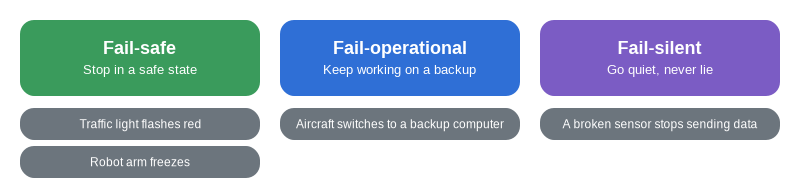
Every system eventually fails. Good design decides in advance how it should fail.
Keeping AI-Driven Systems Safe
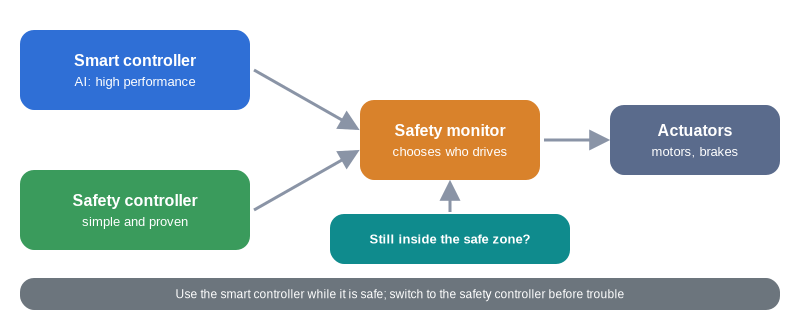
AI can handle situations no one programmed by hand, but it is very hard to prove what it will do in every case. One proven approach, called the Simplex architecture or runtime assurance, lets AI drive while a simple, trustworthy backup watches.
A newer standard, ISO 21448 ("Safety of the Intended Functionality"), covers the Zoox kind of problem: hazards that come from a system misjudging its surroundings, even when nothing is broken.
Safety Standards by Industry
Most standards sort functions into levels by how much harm a failure could cause. Higher levels require more rigorous design and evidence.
| Standard | Where it applies | Levels |
|---|---|---|
| IEC 61508 | General electronic safety systems; the parent of many others | SIL 1 to SIL 4 |
| ISO 26262 | Car electronics and software | ASIL A to ASIL D |
| DO-178C | Aircraft software | Level E to Level A |
| IEC 62304 | Medical device software | Class A to Class C |
| ISO 21448 | Hazards from misjudging the world, not from broken parts | None |
| UL 4600 | Safety cases for autonomous products | None |
Explore Further
NHTSA Recall Search
Browse real U.S. vehicle recalls and defect investigations, including software recalls for driver assistance and robotaxis.
nhtsa.govMIT STPA and CAST Handbooks
Free handbooks from MIT on finding hazards in control systems (STPA) and learning from accidents (CAST), plus Leveson's book Engineering a Safer World.
MIT PSASNASA Fault Tree Handbook
NASA's free guide to building and analyzing fault trees, with aerospace examples.
NASA (PDF)Safe Autonomy blog
Carnegie Mellon's Phil Koopman writes about self-driving car safety, recalls, and standards in plain language.
safeautonomy.blogspot.com