"A model that is right ninety percent of the time, looking for a disease that one patient in a hundred has, will be wrong about nine of every ten patients it flags. Nothing is broken. That is what ninety percent means at that base rate."- Claude 2026
Cognitive Computing in Health and Medicine
Medicine is where these systems meet their hardest test — not because the problems are technically harder, but because a wrong answer has a person attached to it. This is the field with the most deployed systems, the best evidence, and the most instructive failures.
Learning objectives
By the end of this page you should be able to:
- Describe the applications of cognitive computing in healthcare and medicine.
- Explain the role of AI in diagnostics and therapeutic decision-making.
- Analyze healthcare case studies built on cognitive computing systems.
Where These Systems Actually Are
Cognitive computing in medicine means systems that take in clinical information — an image, a note, a stream of vital signs — and produce something a clinician would otherwise have had to work out: a finding, a risk estimate, a draft, a ranked list. Most are built with machine learning, which means they learned the mapping from examples rather than being given rules by a physician.
Six areas of use
Imaging and diagnostics
Detecting nodules, bleeds, fractures, and diabetic eye disease; measuring ejection fraction; flagging a stroke study so it moves to the top of the list. Built on the same convolutional architectures used for everyday image recognition.
Ambient documentation
Listening to the visit and drafting the note. The fastest-spreading clinical AI of the past three years, and the one with the least regulatory friction, because it produces a draft a human signs rather than a diagnosis. Uses speech recognition plus language modelling.
Risk prediction
Early-warning scores for sepsis, deterioration, readmission, and no-shows, running continuously against the electronic health record. The area with the widest gap between how many are deployed and how many have been validated where they run.
Triage and operations
Bed management, staffing, scheduling, coding, prior authorization, and worklist ordering. Unglamorous, rarely regulated as a medical device, and often where the measurable money is.
Discovery and genomics
Protein structure prediction, candidate molecule generation, variant interpretation, and trial matching. Here the output is a hypothesis for a laboratory to test, so a wrong answer costs time rather than a patient.
Monitoring and patient-facing tools
Atrial fibrillation detection on a watch, remote monitoring after discharge, symptom checkers, and chatbots. The only category where the system's user is the patient, with no clinician between the output and the decision.
What has been authorized, and where
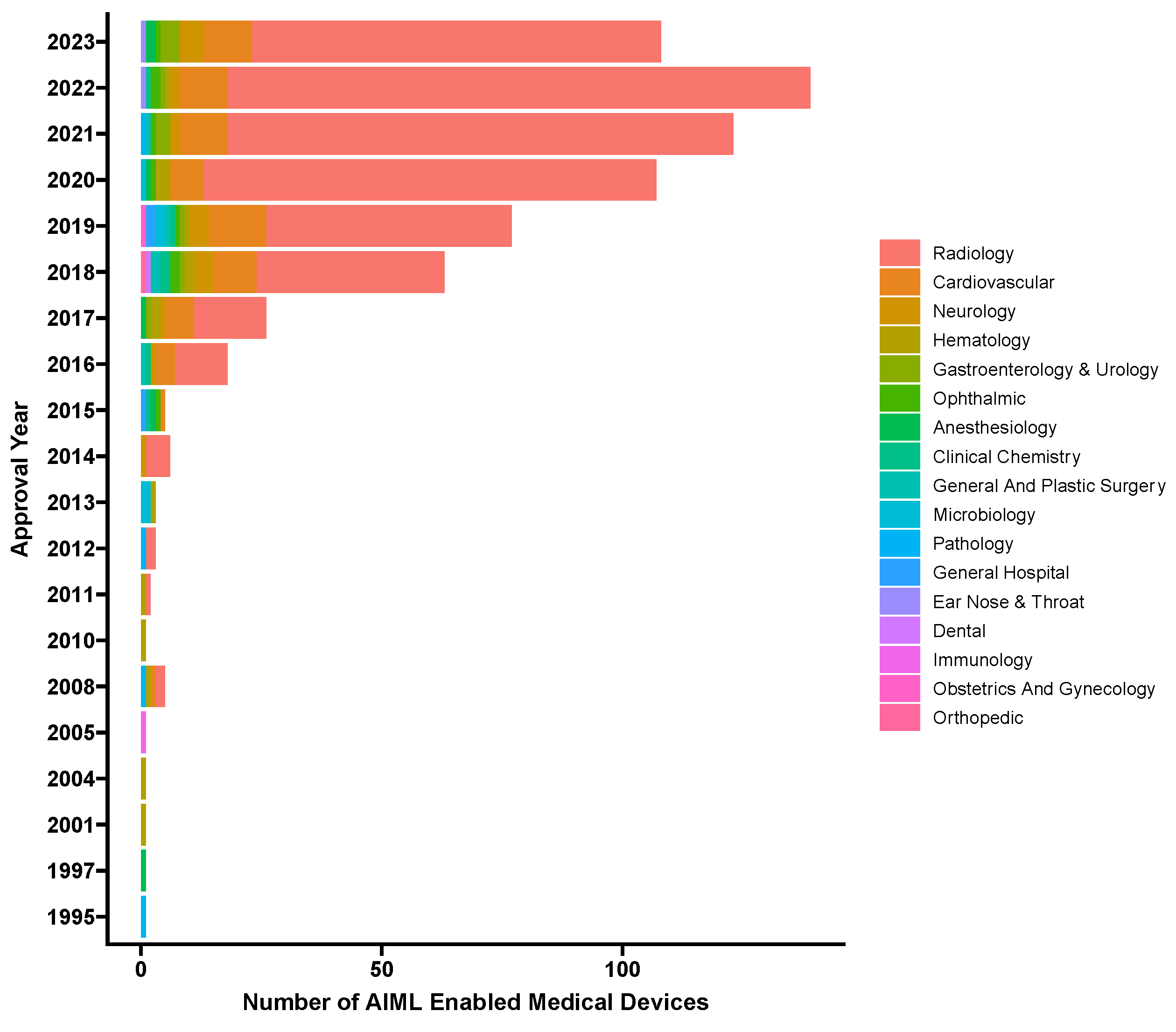
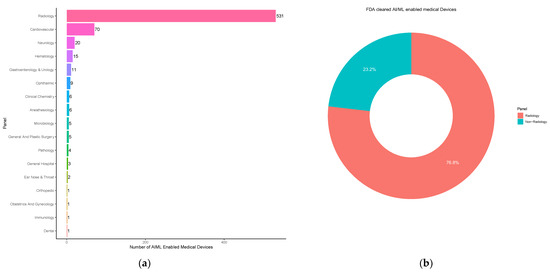
The clearest picture of the field is the US Food and Drug Administration's list of AI-enabled medical devices, which is public and updated periodically. Two things stand out: the near-vertical growth since roughly 2015, and how lopsided it is by specialty.
Task, input, and what actually changes
| Input | Task | What changes in practice |
|---|---|---|
| CT, MRI, X-ray | Detect, measure, prioritize | Order of the worklist, and a second read that never gets tired |
| Retinal photograph | Screen for referable disease | Screening happens in a primary care office rather than requiring a specialist |
| Pathology slide | Grade, count, find rare cells | Quantification that a person cannot do consistently across thousands of fields |
| Vitals and labs stream | Predict deterioration | An alert — the hardest output to act on well, and the easiest to ignore |
| Conversation audio | Draft the clinical note | Where the clinician's attention goes during the visit |
| Molecular and genomic data | Predict structure, function, effect | Which experiments get run first |
Clinical reasoning, human and machine
An experienced clinician recognizes a presentation the way a trained network recognizes an image — rapidly, from thousands of prior examples, often faster than the reasoning can be articulated. Both are doing statistical pattern matching against accumulated cases.
A person facing an ambiguous case orders another test, examines the patient again, or waits. The model has one shot at one input, cannot seek evidence, and cannot say "I need more information" unless someone built it a way to.
Diagnostics and Therapeutic Decision-Making
A diagnostic model outputs a number. Turning that number into a decision requires two things the model does not supply: how common the disease is in the population being tested, and what happens next to the people it flags.
The base-rate problem
Take a genuinely good model — 90% sensitivity, 90% specificity — and apply it to 10,000 people in a population where 1% have the disease. The arithmetic is unforgiving.
| Has disease (100) | No disease (9,900) | Total flagged | |
|---|---|---|---|
| Model says positive | 90 | 990 | 1,080 |
| Model says negative | 10 | 8,910 | 8,920 |
Levels of clinical autonomy
"AI diagnosis" covers four quite different arrangements, and what changes between them is not the model but who is answerable for the result.
| Level | What the system does | What it changes |
|---|---|---|
| Flag | Marks a study or patient as possibly abnormal | Attention. The clinician still reads everything; nothing is removed from their work. |
| Triage | Reorders the queue so urgent cases surface first | Time to treatment. Nobody is missed on purpose, but the ordering is now trusted. |
| Assist | Offers a finding, measurement, or draft the clinician accepts or rejects | The clinician's judgment is now anchored by the machine's — for better and for worse. |
| Autonomous | Issues a clinical result with no expert review | Everything. Liability shifts to the developer, and the evidence bar becomes a prospective trial. |
Why a good model stops working at the next hospital
The most common failure in clinical AI is not a model that never worked. It is a model that worked, and then did not, somewhere else. The usual cause is that it learned something real but irrelevant.
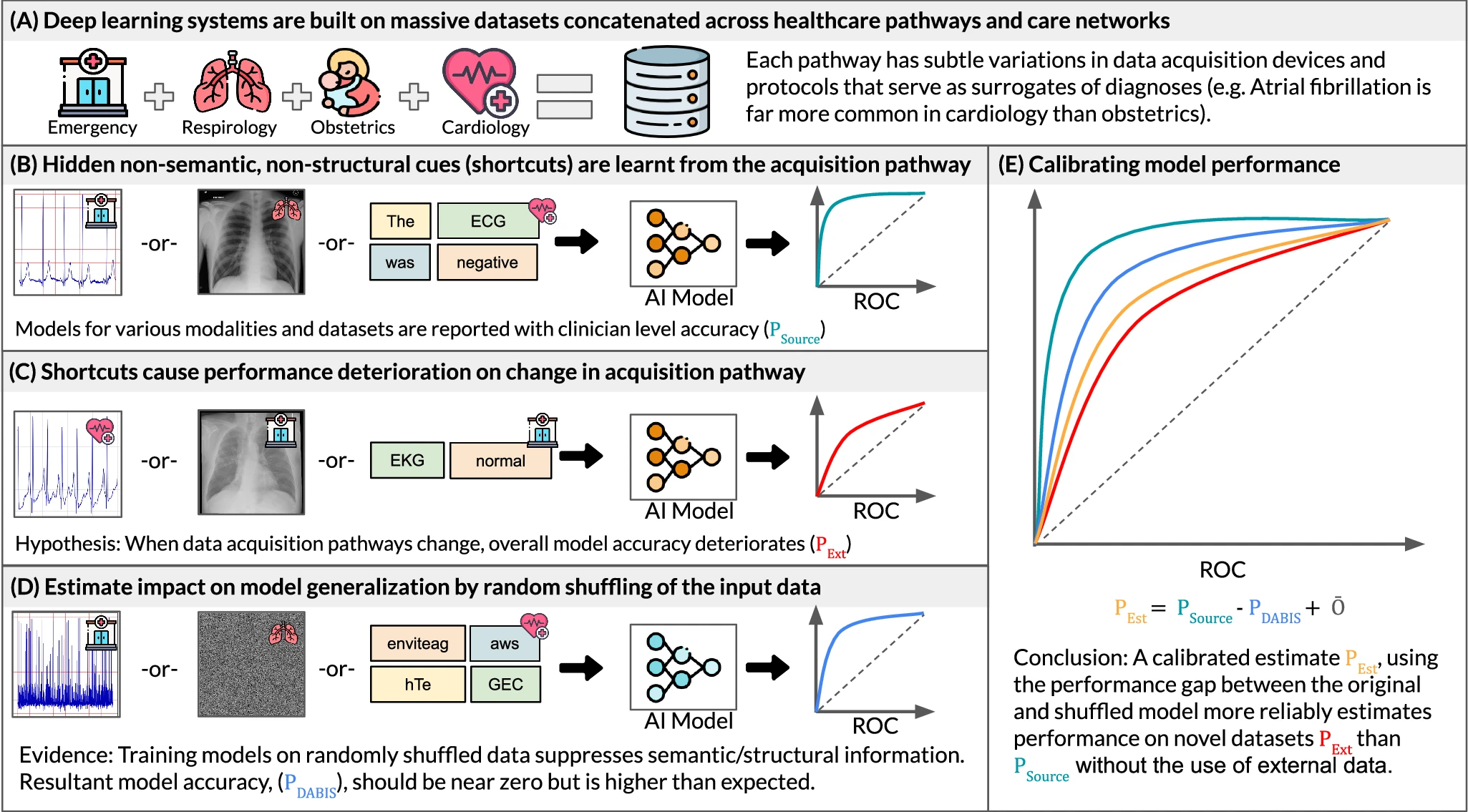
This is shortcut learning: the model finds whatever predicts the label most cheaply. If sicker patients are scanned on the older machine, or portable chest films are taken on people too ill to walk, then scanner artifacts and view type predict disease in that dataset — and the model will use them, because it has no notion that they are not part of the illness. It scores brilliantly on held-out data from the same hospital, because the shortcut is present there too. It fails at the hospital next door, where the equipment and the referral pathway differ.
From a prediction to a treatment decision
The alert has to be actionable
A risk score is only useful if there is something specific to do about it, someone whose job it is to do it, and time in which doing it helps. An accurate warning delivered to a busy unit with no attached protocol changes nothing except the number of alerts.
Alert fatigue is a dose-response problem
Every false alarm lowers the response rate to the next one. A system that fires on a fifth of all patients trains the staff to dismiss it, and the dismissal generalizes to the true positives.
Automation bias runs both ways
Clinicians shown a model's answer first tend toward it, including when it is wrong, and are measurably less likely to catch findings the model missed. The order in which information is presented is a design decision with clinical consequences.
The target is rarely the outcome
Models are trained on what was recorded — a billing code, a documented diagnosis, an order placed — not on what was true. Treatment decisions inherit whatever gap sits between the two.
What counts as evidence
- External validation — performance measured at sites that contributed nothing to training. Internal test-set accuracy tells you the model learned the dataset; only external data tells you it learned the disease.
- Prospective evaluation — running on patients as they arrive, rather than on a curated archive. Retrospective datasets have been cleaned, labelled at leisure, and stripped of the ambiguous cases that dominate real practice.
- Reporting standards — CONSORT-AI adds fourteen items for trials of AI interventions, covering how the system sits in the care pathway, how humans interact with it, and how failures were analyzed. DECIDE-AI covers the earlier stage — first clinical use, usability, learning curves, and safety.
- Outcomes, not accuracy — the question is whether patients did better, not whether the AUC was high. Very few deployed systems have been evaluated this way, which is the single largest gap in the literature.
- Ongoing monitoring — practice patterns, equipment, and populations drift. A model frozen at the moment of approval is measuring a world that is quietly moving away from it.
Two ways of being right
Clinicians are taught to weigh a test result against pre-test probability, which is Bayes' rule in clinical dress. A well-calibrated model does the same arithmetic — when someone remembers to give it the right prior for the population it is actually screening.
A clinician meeting an unfamiliar presentation notices the unfamiliarity and escalates. A model given an input unlike anything in its training set returns a confident number anyway, because nothing in the architecture represents "I have not seen this before".
Four Case Studies
These four are chosen because they disagree with each other. Two are widely called successes and two are widely called failures, and the difference between them is not model quality.
Diabetic eye disease is a leading cause of blindness in working-age adults, and it is preventable if caught — but screening requires an eye specialist, and most patients never go. An autonomous system placed in primary care offices reads the retinal photograph and returns a result with no specialist involved.
The pivotal trial: 900 patients across 10 primary care sites, operators with no prior imaging experience. Sensitivity 87.2%, specificity 90.7%, and 96.1% of patients produced usable images. It exceeded every pre-specified endpoint and became the first autonomous AI diagnostic authorized by the FDA in any field.
Why it worked: a bounded question with an objective reference standard, a population defined in advance, a prospective trial in the setting of intended use, and a genuine gap in care — the alternative was not a specialist, it was nothing.
Sepsis kills quickly and treatment is time-critical, so a proprietary prediction model built into a major electronic health record was switched on at hundreds of US hospitals. Its developer reported an AUC of 0.76–0.83.
The external validation: across 38,455 hospitalizations at Michigan Medicine, the model achieved an AUC of 0.63. At the recommended threshold it identified 33% of sepsis cases — missing 1,709 patients who had it — while generating alerts on 18% of all hospitalized patients. It caught just 183 cases that were not already being treated in time.
Why it failed: it was never externally validated before mass deployment, the label was defined by billing and treatment records rather than the illness, and the alert burden guaranteed fatigue. Nothing about it was unusual — which is the point.
The most heavily marketed clinical AI of the 2010s promised to read the oncology literature and recommend treatment. It was sold to hospitals internationally on the strength of a famous quiz-show demonstration.
What emerged: internal documents reported by STAT described "multiple examples of unsafe and incorrect treatment recommendations". The system had been trained substantially on hypothetical cases devised by a small group of clinicians at one institution rather than on real patient outcomes, so it reproduced local practice preferences and could not generalize. The programme was eventually wound down after roughly $4 billion in acquisitions.
Why it failed: no ground truth. Oncology has no objective label for "correct treatment" the way a retinal photograph has one for "referable disease", and the project never confronted that.
Clinicians spend an enormous share of their time typing notes, and documentation burden is among the strongest predictors of burnout. Ambient systems listen to the visit and draft the note for the clinician to edit and sign.
The trial: a 2026 randomized crossover study in JAMIA put 160 outpatient clinicians through two competing products. Both reduced personal and work-related burnout. Time on notes fell by roughly 6 to 9 minutes per day. Neither tool reduced after-hours "pyjama time". Four percent of users reported accuracy concerns requiring careful editing.
Why it counts as success: a modest, measured, real benefit — and an honest null result on the outcome everyone hoped for. The failure mode here is not a wrong diagnosis but a plausible-sounding note nobody reads before signing.
Ship-and-freeze versus monitor-and-update
The sepsis model and the retinopathy system differed less in their mathematics than in what happened after deployment. Most clinical AI is still deployed the first way.
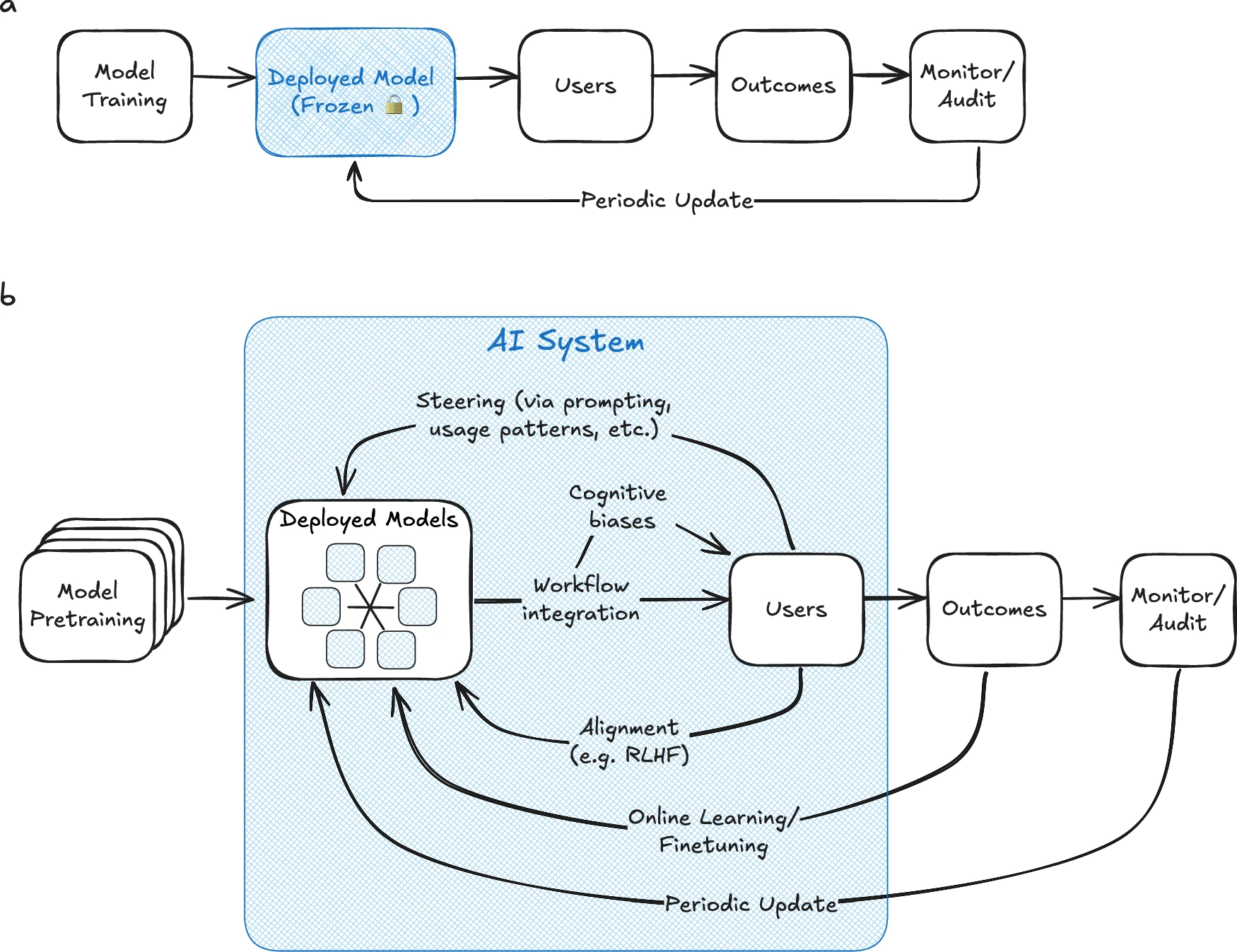
What actually separated them
| Retinopathy screening | Sepsis model | Oncology advisor | Ambient notes | |
|---|---|---|---|---|
| Objective ground truth | Yes | Proxy label | None | The transcript |
| External validation first | Prospective trial | After deployment | No | Randomized trial |
| Fits the workflow | Replaces a missing step | Adds alerts | Adds a second opinion nobody asked for | Removes typing |
| Cost of a false positive | A specialist visit | Fatigue, then ignored alarms | A wrong treatment | An edit |
Read down the columns and the pattern is plain: the successes had a defined question with a checkable answer, evidence gathered before deployment rather than after, and a place in the workflow where they subtracted work instead of adding it. None of that is about model architecture.
- What exactly is the label, and who assigned it — a pathologist, a billing code, or another algorithm?
- Was it validated at sites that contributed no training data, and was that validation prospective?
- What is the prevalence in the deployment population, and what does the positive predictive value become there?
- Where does the output land in someone's day, and what are they meant to do differently because of it?
- What patient outcome improved — not what the AUC was?
- Who is watching for drift after deployment, and what triggers taking it offline?
Where the analogy holds and where it breaks
Residency is supervised learning with a slow feedback loop and a small sample. Where the reference standard is objective and the cases are plentiful, the machine's version of that process genuinely can exceed the human one — retinal screening is the existence proof.
Most of clinical work is deciding what matters, negotiating with a patient about it, and revising as things unfold. The parts that reduce to a labelled input are the parts that automate — which is why the wins cluster in imaging and the failures cluster in treatment.
Tools & Tutorials
- MONAI — the standard open-source framework for medical imaging AI, with tutorials covering annotation in 3D Slicer, transformer architectures for volumetric data, and packaging a model as a deployable application.
- MIMIC-IV Clinical Database Demo — 100 deidentified intensive care patients from a real hospital, downloadable as CSV with no credentialing required. The fastest way to see what clinical data actually looks like before committing to the full credentialed dataset.
- MedGemma — open multimodal models tuned for medical text and images, with Colab and Kaggle notebooks for chest X-ray question answering and fine-tuning. Useful for seeing how far a general model gets on clinical tasks, and where it stops.
- Grand Challenge — hundreds of biomedical imaging challenges with public datasets, leaderboards, and held-out test sets, filterable by modality, anatomy, and task. Benchmarks you cannot accidentally overfit to.
- FDA AI-Enabled Medical Devices list — the searchable, periodically updated register of every authorized device. Look up any product a vendor is selling you.
Further reading
- Abràmoff, M. D., Lavin, P. T., Birch, M., Shah, N., & Folk, J. C. (2018). Pivotal Trial of an Autonomous AI-Based Diagnostic System for Detection of Diabetic Retinopathy in Primary Care Offices. npj Digital Medicine, 1, 39. — the trial behind the first autonomous AI authorization; a model of how to design one.
- Wong, A., et al. (2021). External Validation of a Widely Implemented Proprietary Sepsis Prediction Model in Hospitalized Patients. JAMA Internal Medicine, 181(8), 1065–1070. — the paper that changed how hospitals talk about vendor-supplied models.
- Comparing Ambient Scribes: A Randomized Crossover Clinical Trial Addressing Ambient Scribe Technologies' Impact on Physician Burnout (2026). JAMIA, 33(5), 990. — a rare head-to-head trial of deployed clinical AI, with a useful null result.
- Liu, X., Cruz Rivera, S., Moher, D., Calvert, M. J., & Denniston, A. K. (2020). Reporting Guidelines for Clinical Trial Reports for Interventions Involving Artificial Intelligence: the CONSORT-AI Extension. Nature Medicine, 26, 1364–1374.
- Vasey, B., et al. (2022). Reporting Guideline for the Early-Stage Clinical Evaluation of Decision Support Systems Driven by Artificial Intelligence: DECIDE-AI. Nature Medicine, 28, 924–933. — covers the stage where most systems quietly fail.
- Ong Ly, C., et al. (2024). Shortcut Learning in Medical AI Hinders Generalization. npj Digital Medicine, 7, 124. — demonstrates the problem across 13 datasets and 5 modalities, and proposes a way to estimate external performance without external data.
- Rethinking Clinical Trials for Medical AI with Dynamic Deployments of Adaptive Systems (2025). npj Digital Medicine. — argues that evaluating a frozen model misses the point when the deployed system keeps changing.
- Joshi, G., et al. (2024). FDA-Approved Artificial Intelligence and Machine Learning (AI/ML)-Enabled Medical Devices: An Updated Landscape. Electronics, 13(3), 498. — the source of the charts above, with the full breakdown by panel, year, and regulatory pathway.
- IBM's Watson Gave "Unsafe and Incorrect" Cancer Treatment Advice (2018). MedTech Dive, on the STAT investigation. — the contemporaneous reporting on the oncology case.