
Foundations
Introduction to
Quantum Computing
Every computer you have ever used works with bits — tiny switches that are either off or on. Quantum computers work with something stranger: qubits, which follow the rules of quantum physics. This page explains what a qubit is, how quantum computers operate on qubits, and why that makes them a fundamentally different kind of machine rather than just a faster one.
The Qubit
From Bits to Qubits
An ordinary computer stores information as bits. Each bit is like a light switch: it is either off (0) or on (1), and you can always look at it without changing it.
A qubit (short for quantum bit) is different. Before you look at it, a qubit can be in a blend of 0 and 1 at the same time, with some "weight" on each. This blend is called superposition. When you finally measure the qubit, the blend disappears and you get a plain 0 or 1 — and the weights decide how likely each answer is. (A qubit's state is written |ψ⟩ = α|0⟩ + β|1⟩, where α and β are complex numbers called amplitudes. Measuring gives 0 with probability |α|² and 1 with probability |β|², and |α|² + |β|² = 1.)
Unlike ordinary probabilities, these weights can be negative or even point in different "directions." That is what lets them cancel each other out — the key ingredient behind every quantum speedup. (Amplitudes carry a phase; relative phase between |0⟩ and |1⟩ is physically meaningful even though it doesn't change a single measurement's probabilities.)
Engineers build qubits from many physical systems: tiny superconducting circuits cooled close to absolute zero (Google, IBM), individual charged atoms held by electric fields (IonQ, Quantinuum), neutral atoms held by lasers (QuEra, Atom Computing, Pasqal), particles of light (PsiQuantum, Xanadu), and electrons in silicon chips (Intel, Diraq). Each trades off how long a qubit stays stable, how fast it can be operated, and how many can be packed together. The physics behind superconducting qubits earned the 2025 Nobel Prize in Physics. (Clarke, Devoret and Martinis, for macroscopic quantum tunnelling and energy quantisation in an electric circuit. The largest neutral-atom arrays now hold about 6,100 trapped atoms; the largest single superconducting chips have just over 1,000 qubits.)
Visualising a Qubit
Core Principles
Superposition
A qubit can hold a blend of 0 and 1 until it is measured. Several qubits together can hold a blend of every possible combination of 0s and 1s. This does not mean a quantum computer simply tries every answer at once — measuring only ever gives one result. The power comes from what happens to the blend before it is measured. (The Hadamard gate creates an equal superposition: H|0⟩ = (|0⟩ + |1⟩)/√2. n qubits span 2ⁿ basis states.)
Entanglement
Two or more qubits can become linked so that they can only be described together, not one at a time. Measure one, and the result is perfectly coordinated with what the other will show — no matter how far apart they are. The link can't be used to send messages faster than light, but it is a key resource for quantum algorithms and secure communication. (An entangled state cannot be written as a product of single-qubit states, e.g. (|00⟩ + |11⟩)/√2.)
Interference
Like ripples on a pond, the weights in a quantum blend can add up (making an outcome more likely) or cancel out (making it less likely). A quantum algorithm is a carefully choreographed sequence that makes wrong answers cancel and right answers reinforce. (Amplitudes add as complex numbers: constructive interference increases |amplitude|², destructive interference decreases it.)
Measurement
Looking at a qubit forces it to pick a plain 0 or 1, and the blend is gone for good. That is why measurement is the last step of a quantum computation: everything before it is arranged so that the right answer is the most likely thing you'll see. (Measurement projects the state onto a basis state with probability given by the squared amplitude — the Born rule.)
Quantum Gates
Operations on Qubits
Ordinary computers process bits with logic gates like AND, OR and NOT. Quantum computers process qubits with quantum gates. One big difference: every quantum gate can be run backwards. Nothing is ever erased in the middle of a quantum computation — information is only rearranged. (Quantum gates are unitary matrices, so every gate U has an inverse U†.)
Single-qubit gates turn one qubit's blend into a different blend — on the Bloch sphere, they rotate the globe. The X gate swaps 0 and 1, like a NOT gate. The Z gate flips the "direction" of the 1 part without changing the odds. The Hadamard gate turns a plain 0 or 1 into an even blend. (Pauli X, Y, Z are 180° rotations about the corresponding axes; S and T apply 90° and 45° phase rotations.)
Two-qubit gates let qubits affect each other. The most common, the controlled-NOT, flips a second qubit only when the first qubit is 1 — and applied to a qubit in a blend, it creates entanglement. A small toolkit of single-qubit gates plus this one two-qubit gate is enough to build any quantum computation. (CNOT plus arbitrary single-qubit rotations form a universal gate set; a finite set such as {H, S, T, CNOT} approximates any unitary to arbitrary precision.)
Quantum Circuit Diagrams
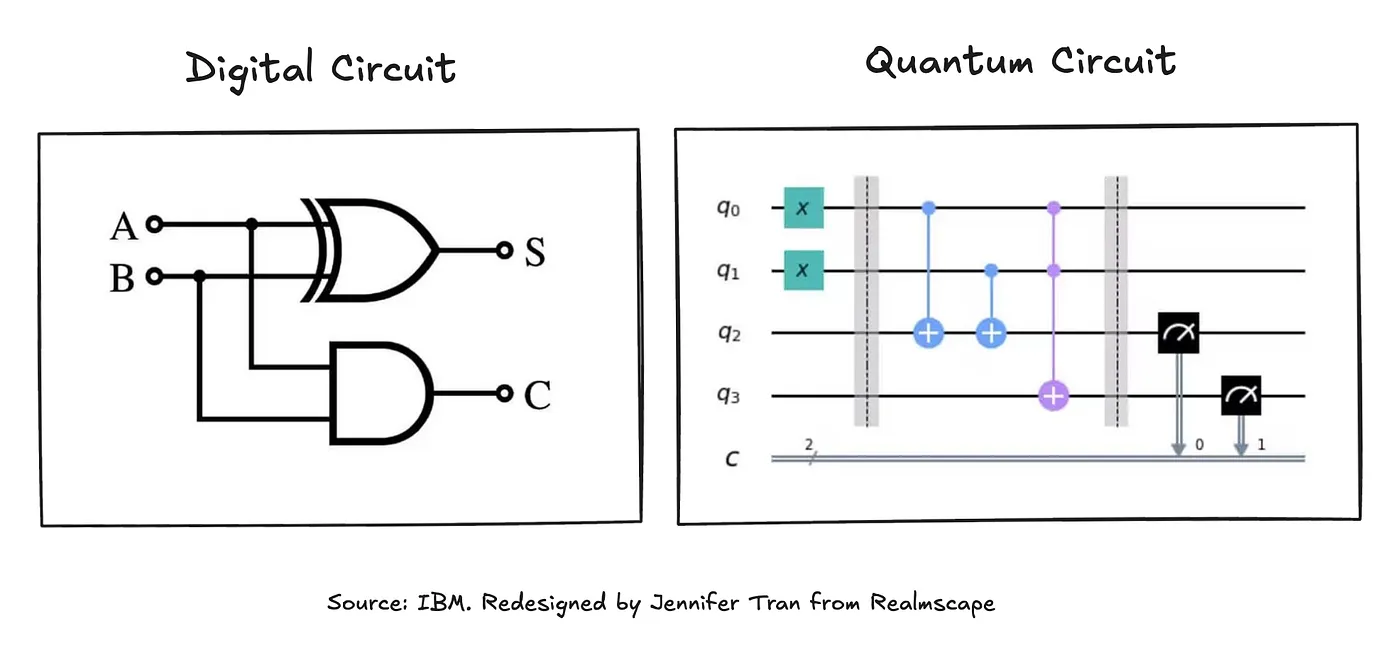
Classical vs Quantum Computing
Where Things Stand
Quantum Advantage — Claimed, Contested, Narrowing
"Quantum advantage" means a quantum computer doing something no ordinary computer can match in reasonable time. Google claimed the first such result in 2019 on a deliberately artificial task, and IBM and partners announced three more advantage experiments in July 2026. Each claim has prompted classical researchers to look for faster ordinary-computer methods — and they sometimes succeed: within weeks, one of IBM's July experiments was reproduced on a cluster of graphics processors in about 37 minutes. (IBM's claims ran on the 156-qubit Heron processor; the classical response, arXiv:2608.13110, used tensor-network contraction on 256 GPUs.)
The honest summary: today's machines can beat the best known classical methods on carefully chosen benchmark problems, but a clearly useful result that no classical computer can reproduce has not yet been demonstrated. Most researchers expect that to require error-corrected machines, which are covered later in this series.