
Entanglement
Quantum Entanglement
& Cryptography
Einstein called it "spooky action at a distance" — two particles whose fates stay linked no matter how far apart they travel. It sounds like science fiction, but it is real, experimentally confirmed, and now the basis for the most secure form of encryption physics allows.
What Is Quantum Entanglement?
When Two Particles Share One Fate
Imagine two coins that always land on opposite faces — every time, instantly, even if one is on Earth and the other on the Moon. Measuring one tells you the other immediately. Entangled particles behave like this: their properties are linked so tightly that they can't be described separately, only as a single shared system. (Formally: two systems are entangled when their joint state cannot be written as a product of individual states.)
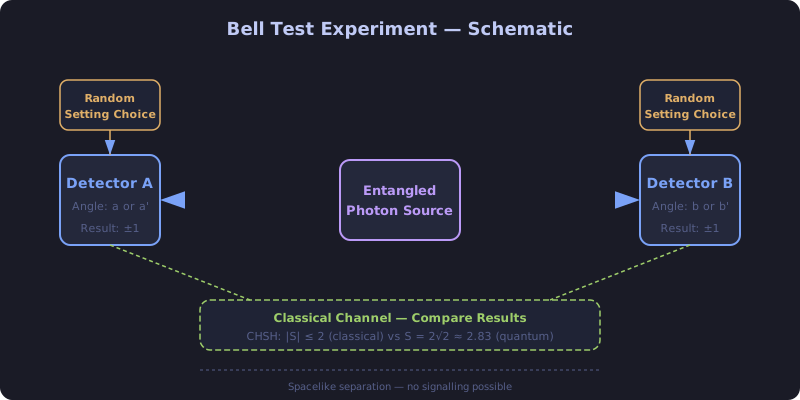
This is not a signal racing faster than light. Nothing useful is sent at the moment of measurement — the link only becomes visible when the two parties later compare notes over an ordinary channel. What makes it genuinely non-classical is how strong the link is: stronger than any explanation in which the answers were secretly fixed in advance. (The correlations exceed any local hidden-variable model.)
Einstein, Podolsky, and Rosen flagged this in 1935 as a paradox, arguing quantum mechanics must be incomplete. In 1964 John Bell proved the two views make different, testable predictions. Decades of increasingly careful experiments — recognized with the 2022 Nobel Prize in Physics — have come down firmly on the quantum side, ruling out the "secretly fixed in advance" explanation. (Bell's theorem: any local hidden-variable theory makes predictions distinguishable from quantum mechanics; experiments confirm the latter, ruling out local realism.)
Bell Test Experiments
Key Concepts
Bell States
The four basic ways two particles can be maximally entangled — the building blocks of entanglement. In each, measuring one particle instantly tells you the matching result for the other. (Four maximally entangled two-qubit states forming a complete orthonormal basis, e.g. |Φ+⟩ = (|00⟩ + |11⟩)/√2.)
CHSH Test
A scorecard that measures how strong the link between particles is. Anything explainable by ordinary physics scores at most 2; genuine entanglement scores higher — up to about 2.83 — and that gap is the experimental proof. (|E(a,b) − E(a,b') + E(a',b) + E(a',b')| ≤ 2 classically; quantum systems reach 2√2 ≈ 2.83.)
Quantum Teleportation
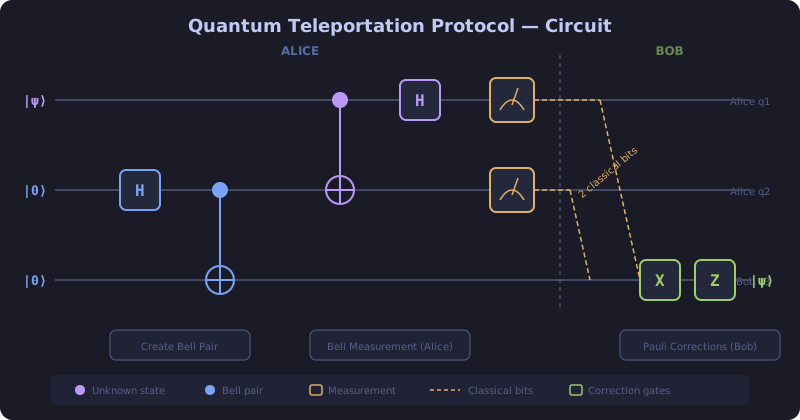
Moving a quantum state from one place to another without sending the particle itself. Alice measures her particle alongside the unknown state, sends Bob two ordinary bits, and Bob reconstructs the original — which vanishes from Alice's end. (Pre-shared Bell pair + Bell-state measurement + 2 classical bits + corrective Pauli unitary; the no-cloning theorem requires the original be destroyed.)
Superdense Coding
The mirror image of teleportation: using one shared entangled particle, Alice sends two bits of information while physically transmitting just one particle. Entanglement doubles how much a single quantum particle can carry. (One pre-shared entangled qubit lets one transmitted qubit convey two classical bits.)
The Quantum Teleportation Protocol
Entanglement in Cryptographic Security
Device-Independent QKD
Ordinary quantum encryption assumes your hardware works exactly as the manufacturer claims. But what if you don't trust the manufacturer? Device-independent QKD removes that assumption entirely. It certifies security by checking that the devices produce the "impossible" correlations of genuine entanglement — correlations no adversary could fake by secretly pre-programming the hardware. (Security is certified by observing a Bell inequality violation, which rules out pre-programmed classical responses.)
This is the strongest security guarantee possible: it holds even if your adversary built the equipment. The E91 protocol is the classic example. (Bell-test certification means even adversary-supplied devices can be verified.)
Current status: Once purely theoretical, device-independent QKD has moved into the lab fast. First demonstrated at small scale around 2021–2022, a February 2026 result in Science extended it to two single-atom nodes connected by 100 km of fiber — far enough for city-wide secure networks, with error rates rising from about 3% at 11 km to over 7% at 100 km. Practical key rates remain the active challenge, demanding very high detector efficiencies and loophole-free Bell tests. (Nadlinger et al. 2022, ~2 m; Science 2026, 100 km metropolitan-scale.)
Implementation Challenges