
Open Problems: The Landscape
TCS open problems differ from many scientific unknowns — they are precisely stated mathematical conjectures whose resolution would restructure our understanding of computation. The most celebrated, P vs NP, has been open since 1971 and carries a $1,000,000 Clay Millennium Prize. The field's other open problems are nearly as deep.
P vs NP
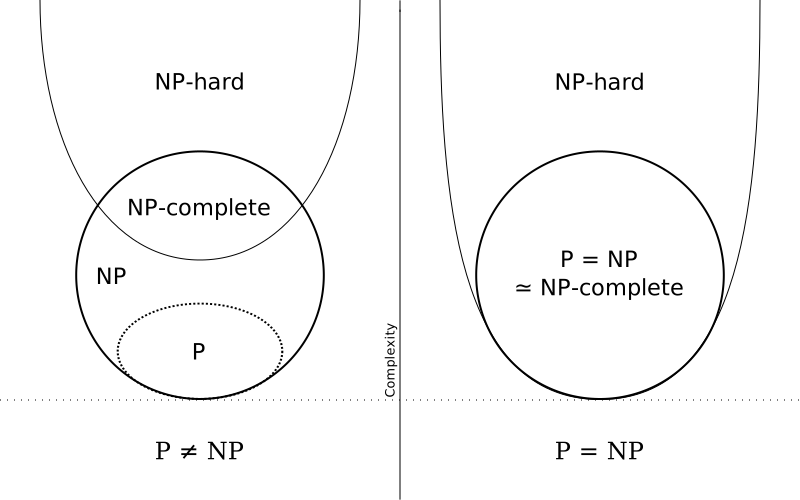
Is every problem whose solution can be verified in polynomial time also solvable in polynomial time? Consensus is P ≠ NP, but no proof exists. Resolution either way would be the most consequential result in the history of mathematics and computer science.
Do One-Way Functions Exist?
Implies P ≠ NP but is believed to be strictly stronger. All of modern cryptography depends on this conjecture. No proof of existence or non-existence is known. Equivalent to asking whether Minicrypt (Impagliazzo) is the world we live in.
NP vs co-NP
Does every NP problem have short proofs of non-membership? If NP = co-NP, the polynomial hierarchy collapses. Believed false. Would imply P ≠ NP; precise relationship to P vs NP is not fully understood.
Circuit Lower Bounds
Can we prove NP requires super-polynomial circuit size? No NP problem has been shown to need circuits larger than Ω(n log n). The Razborov-Rudich "natural proofs" barrier (1994) explains why combinatorial techniques cannot work — a rare case where mathematicians know why a problem resists proof.
L vs P
Can every polynomial-time problem be solved in O(log n) space? L ⊆ P is known. Settling L = P would determine whether memory is as powerful as time for polynomial computations, with implications for parallel algorithms.
Unique Games Conjecture
Khot's 2002 conjecture that the Unique Games problem is NP-hard has become central to inapproximability theory. Work by Dinur, Khot, Kindler, Minzer, and Safra (2023) made significant structural progress via the Sum-of-Squares hierarchy, though the conjecture remains open.
P vs NP: Why Three Known Barriers Block Every Proof Attempt
Fifty-four years of effort by the best mathematical minds have made no progress on resolving P vs NP. This is not lack of effort — it reflects three known mathematical barriers that rule out entire classes of proof techniques:
- Relativization (Baker-Gill-Solovay, 1975): There exist oracles A, B such that PA = NPA and PB ≠ NPB. Any proof technique that works the same with or without oracles (a "relativizing" technique) cannot separate P from NP. Most standard diagonalization arguments are relativizing.
- Natural Proofs (Razborov-Rudich, 1994): Any proof technique that is "natural" — constructive, applicable to a large fraction of functions, and useful for distinguishing functions — cannot prove super-polynomial circuit lower bounds, unless strong pseudorandom functions do not exist. Most combinatorial lower-bound arguments are natural.
- Algebrization (Aaronson-Wigderson, 2009): Extends the relativization barrier to algebraic proof techniques. Most methods using algebraic extensions of Boolean functions also algebrize and cannot resolve P vs NP.
A proof of P ≠ NP must be non-relativizing, non-natural, and non-algebrizing — a very narrow target. No one currently knows what such a proof would look like.
Emerging Research Areas
Despite its deepest problems remaining open, TCS is one of the most active areas in contemporary mathematics. New subfields have emerged at intersections with quantum mechanics, learning theory, combinatorics, and information theory.
Meta-Complexity
Studies the computational complexity of reasoning about complexity itself — e.g., how hard is it to decide if a given circuit is the minimal circuit for a function? Recent breakthroughs connect meta-complexity to cryptography and average-case hardness, creating new foundations for both fields.
Quantum Complexity Theory
Characterises what quantum computers can and cannot do efficiently. Key classes: BQP (quantum polynomial time), QMA (quantum NP). Whether BQP = NP is unknown. Post-quantum cryptography depends on NP problems being hard for BQP — specifically that factoring and lattice problems remain hard quantumly.
Fine-Grained Complexity
Proves precise conditional lower bounds for problems already in P — e.g., the Strong Exponential Time Hypothesis (SETH) implies that improving O(n²) algorithms for edit distance or satisfiability would have dramatic consequences. Grounds practical algorithm design in hardness assumptions.
Proof Complexity
Studies lower bounds on the length of formal proofs in systems like resolution, Frege, and polynomial calculus. Tightly connected to circuit lower bounds and P vs NP. Recent work via Sum-of-Squares has transformed our understanding of which optimization problems can be efficiently approximated.
Learning Theory and Complexity
PAC learning, statistical query complexity, and the hardness of learning. Recent research connects deep learning theory to complexity questions about what function classes are efficiently learnable and why gradient descent finds good solutions — bridging practice and theory.
Algorithmic Game Theory
Complexity of computing Nash equilibria (PPAD-complete), mechanism design, and social choice. Underpins theoretical analysis of internet auctions, routing protocols, and multi-agent AI systems — connecting TCS directly to economics and modern AI infrastructure.
Automata Theory: New Frontiers
Classical automata theory remains foundational, but contemporary research extends it into domains that would have seemed exotic to its founders.
- Automata learning (Angluin's L*): Efficiently learn an unknown DFA from membership and equivalence queries. Widely applied in software verification and protocol analysis. Active research extends this to weighted, probabilistic, and nominal automata.
- Nominal automata: Automata over infinite alphabets equipped with symmetries (e.g., all IP addresses, all session identifiers). Classically, automata theory assumed finite alphabets; nominal automata generalise to register machines and have applications in XML processing and session type theory.
- Timed and hybrid automata: Models for real-time and cyber-physical systems with continuous-time clocks alongside discrete transitions. Reachability is PSPACE-complete for timed automata; analysis tools are widely deployed in embedded systems and automotive safety verification.
- Streaming automata: Automata operating on massive data streams with limited memory. Connects to communication complexity and data structure lower bounds, with applications in network traffic analysis and database query processing over unbounded streams.
Future Applications of TCS in Practice
TCS has a history of surprising practical impact: results proved for purely mathematical reasons become transformative years later. RSA applied number theory; SHA-256 applied collision resistance; error-correcting codes underpin all digital communication. The field's current frontiers suggest similar futures.
| TCS Area | Near-Term Application (2025–2030) | Long-Term Implication |
|---|---|---|
| Lattice Cryptography (LWE) | NIST FIPS 203/204/205 deployment; PQC migration for TLS and PKI | Cryptography grounded in worst-case hardness, resistant to both classical and quantum attacks |
| Probabilistically Checkable Proofs | ZK-SNARKs in blockchain; verifiable AI inference; delegation of computation | Efficiently verifiable proofs of arbitrary computations — trustworthy AI auditing without re-execution |
| Quantum Complexity (BQP, QMA) | Quantum algorithm design; PQC threat timeline modelling | Rigorous characterisation of quantum advantage; quantum simulation of chemistry and drug design |
| Fine-Grained Complexity | Optimal algorithm design with provable time bounds for genomic alignment, edit distance, graph problems | Replacing ad hoc optimisation with hardness-guided algorithm engineering across all of applied CS |
| Automata Learning | Protocol reverse-engineering; network behavioural fingerprinting; firmware analysis | Interpretable AI: learning provably correct finite-state models of neural network behaviour |
| Interactive Proofs / MIP* | Verification of untrusted cloud computation; zero-knowledge identity proofs | MIP* = RE (Ji et al. 2020): entangled quantum provers can verify any computably enumerable statement — deep connections to quantum foundations and Connes' embedding problem |
Scott Aaronson has argued that P vs NP is fundamentally a question about the nature of creativity: is finding a solution as easy as verifying one? If P = NP, there is no obstacle in principle to machines that match human creative problem-solving across all domains — optimising drug molecules, proving theorems, composing music. Kurt Gödel anticipated this in a 1956 letter to von Neumann, asking whether mathematical proof-search could be automated in polynomial time. The question is not merely technical: it is a question about the structure of mathematical truth and the limits of intelligence.