"A fairness metric is not a decision about what is fair. It is a decision about which unfairness you are willing to keep — and that choice belongs to people, not to the optimizer."- Claude 2026
Ethical Considerations in Cognitive Computing
Ordinary software acts on what you do. A cognitive system acts on what it believes is happening inside you — your attention, your intent, your competence, your state of mind. That shift is what makes the ethics of these systems a separate problem rather than a footnote to software engineering.

Learning objectives
By the end of this page you should be able to:
- Explain the ethical issues raised by cognitive computing and artificial intelligence.
- Describe privacy and bias concerns specific to cognitive systems.
- Evaluate the ethical frameworks that guide cognitive computing applications.
The Ethical Issues
Cognitive computing is the design of systems that imitate aspects of human thought — perceiving, learning from data, reasoning toward a conclusion, and acting on it. Most of these systems are built with machine learning: instead of being given rules, they are given examples and infer the rules themselves. That single design choice is the root of nearly everything on this page.
Why this is not just software ethics
They claim interiority
A spam filter classifies a message. A cognitive system classifies you — engaged or distracted, honest or evasive, low-risk or high-risk. The claim is about a mental state no one can check directly, which means the person judged cannot easily contest it.
They operate at scale
A biased interviewer harms the people in one room. A biased screening model applies the same error to every applicant, silently and consistently, and consistency is exactly what makes it hard to notice as error.
They are opaque by construction
The rules were learned, not written. Nobody chose the weights, so nobody can point to the line of reasoning that produced a decision — including the people who built and deployed the system.
Six recurring issues
Opacity and explainability
A model with millions of parameters has no summary a person can hold in mind. Explainable AI methods produce after-the-fact accounts — which features mattered, what would have changed the outcome — but an explanation of a decision is not the same thing as the decision's actual cause, and it is easy to mistake a plausible story for a true one.
The accountability gap
Responsibility disperses across the people who collected the data, trained the model, integrated it, bought it, and followed its output. Each did something reasonable; the harm belongs to none of them individually. This is the problem of many hands, and contracts tend to allocate liability to whoever is least able to inspect the system.
Autonomy and manipulation
A system that models what moves you can be pointed at persuasion as easily as at assistance. The line between a helpful recommendation and an exploited weakness is not technical — it is whether the objective being optimized is the user's or someone else's.
Consent and the inference problem
Consent covers the data you hand over. It does not cover what can be derived from it — and cognitive systems specialize in deriving sensitive conclusions from innocuous inputs. You cannot meaningfully consent to an inference that had not been invented when you clicked "agree".
Automation bias and deskilling
Automation bias is the documented tendency to accept a machine's output over one's own judgment, especially under time pressure. "A human stays in the loop" is only a safeguard if that human still has the skill, information, and standing to say no — and overriding the system is usually the option that requires a written justification.
Concentration and dual use
Training frontier systems requires data, compute, and capital held by very few organizations, so the definition of "acceptable" is set by a small group. And the same emotion or attention model serves accessibility research and workplace surveillance without a single change to the code.
Mental privacy and cognitive liberty
Cognitive computing pushes hardest on a right that older law barely names. Neural data — recordings of brain activity from EEG headsets, brain–computer interfaces, and increasingly consumer wearables — is generated without deliberate action and cannot be edited or withheld the way speech can. Two claimed rights follow: mental privacy, that inferences about your inner states are yours, and cognitive liberty, that your mental processes should not be manipulated or read without consent.
The legal response has been unusually fast, and unusually bipartisan.
| Instrument | Year | What it does |
|---|---|---|
| Chile | 2021 | First country to write neurorights into its constitution, protecting mental integrity and brain activity. |
| Colorado | 2024 | The first US state to protect neural data specifically: express consent to collect or use it, separate consent to disclose it, and a right to deletion. |
| California | 2024 | Amends the state consumer privacy act to cover neural data with equivalent consent and deletion rights. |
| Montana & Connecticut | 2025 | Montana extends its genetic-information privacy law to neural data and to "mental augmentation"; Connecticut folds neural data into its consumer data privacy act. |
| UNESCO | 2025 | The Recommendation on the Ethics of Neurotechnology, adopted 11 November 2025 — the first global standard. Non-binding, but it explicitly extends protection to indirect neural data and to non-neural signals used to infer mental states. |
That last clause is the one that matters for this page: it reaches your eye movements, your typing rhythm, and your voice — anything used to infer what you are thinking — not just electrodes on a scalp. Reporting on the state laws is collected at KFF Health News.
New problem, or old problem at new scale?
Discrimination in lending, surveillance of workers, unaccountable bureaucratic decisions — none of this arrived with machine learning. The categories of harm, and much of the law that addresses them, already existed.
What is new is that the harm is applied uniformly to millions, its reasoning cannot be examined, and it operates on inferred inner states that the subject never disclosed and cannot correct.
Privacy and Bias in Cognitive Systems
These are the two concerns that show up in every regulation and every audit, and they are usually treated as separate. They are not: both are consequences of the same fact, that a learned system's behaviour is determined by data collected from people who were not consulted about it.
Privacy: four distinct failures
Provenance and consent
Training corpora are assembled from scraped, purchased, and repurposed sources. The people in them were rarely asked, and for a model trained years later there is no practical way to ask.
Re-identification
Removing names does not anonymize a record. A handful of ordinary attributes — postcode, birth date, a few timestamps of movement — is usually enough to pick one person out of a national population.
Function creep
Data gathered for one purpose becomes available for another: attendance logs become productivity scores, a safety camera becomes an identification system. Nothing is re-collected, so nothing triggers a new consent step.
The model itself leaks
Trained weights carry traces of the training set. A membership inference attack asks whether a specific record was used; extraction attacks can recover memorized text verbatim. A model is a data release, not just a program.

The inference problem
The privacy question people ask is "what did they collect?" The question that matters for cognitive systems is "what can be derived from it?" A face yields identity, approximate age, and a gaze trace. Typing dynamics carry fatigue. Purchase timing carries a pregnancy. None of these were disclosed; all of them were inferred, and the inference is not covered by the consent given for the raw signal.
This is why "we only store anonymized data" is a weak assurance. The sensitive thing is usually not the record — it is the conclusion the model draws from it.
What actually helps
- Data minimization and purpose limitation — collect the least that answers the question, and bind it to a stated use. The strongest privacy control is the data you never held. This is the core of the GDPR's Article 5 and of every framework that followed it.
- Differential privacy — add calibrated noise so that the output is provably almost the same whether or not any one person's record was included. It gives a mathematical guarantee rather than a promise, at a measurable cost in accuracy, and the privacy budget is spent permanently across all queries.
- Federated learning — train across devices and send model updates instead of raw data. It removes the central store, but updates themselves leak, so it is normally combined with differential privacy or secure aggregation rather than used alone.
- Retention limits and deletion paths — the unglamorous controls that decide whether "delete my data" is a feature or a sentence in a policy document. Deleting a record does not remove its influence on an already-trained model.
Where bias enters
"Biased data" is too coarse to act on. Bias enters at every stage of the lifecycle, and each entry point needs a different fix — which is why a single de-biasing step at training time rarely works.
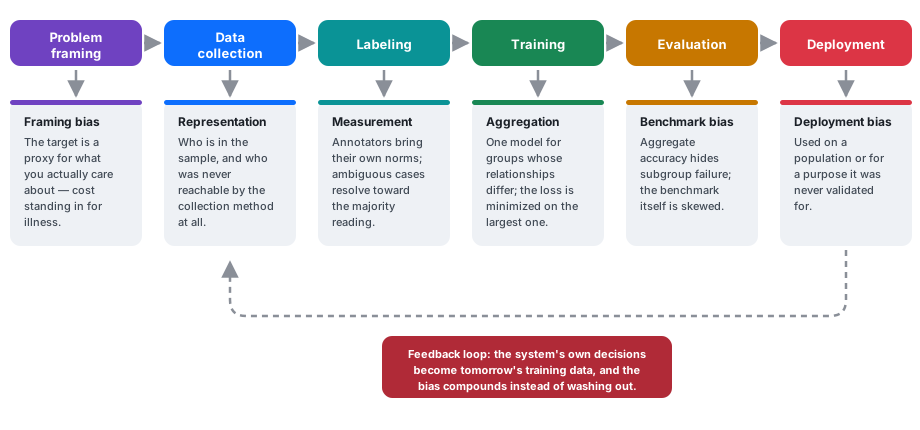
Three definitions of fairness — and why you cannot have all three
Once you decide to measure fairness, you must say what it means. The three standard criteria all sound reasonable and they disagree with each other.
| Criterion | Requires | The intuition it captures |
|---|---|---|
| Demographic parity | Equal selection rates across groups | Outcomes should be distributed proportionally, regardless of what the historical data says |
| Equalized odds | Equal true-positive and false-positive rates across groups | The system should make its mistakes at the same rate on everyone |
| Calibration | A score of 0.7 means the same thing in every group | The number should be honest — a risk score should mean one thing, not two |
This is not an abstract result. It is the COMPAS dispute: a recidivism risk score that was calibrated across racial groups, as its vendor said, while producing a higher false-positive rate for Black defendants, as its critics said. Both claims were arithmetically correct at the same time, because the underlying arrest base rates differed. The disagreement was never about the numbers.
Measuring the gap is the easy half — selection rates, true-positive rates and false-positive rates per group are a few lines of arithmetic, and every fairness toolkit below computes them for you. Deciding which gap to close is the half no toolkit can do.
Two findings worth knowing by name
Gender Shades (2018)
Buolamwini and Gebru audited three commercial gender-classification products across skin tone and gender together. Error for lighter-skinned men: 0.8%. Error for darker-skinned women: up to 34.7%. The lesson is methodological as much as ethical — the disparity was invisible in the headline accuracy and only appeared when the evaluation was intersectional.
The proxy-label case (2019)
An algorithm used on millions of patients ranked need by predicted healthcare cost. Because less is historically spent on Black patients at equal sickness, they had to be sicker to earn the same score. No protected attribute appeared anywhere in the model. Fixing the target variable raised the share of Black patients referred for extra care from 18% to 47%.
The general lesson. Removing sensitive attributes from the inputs does not remove bias — it removes your ability to detect it. Both cases were found by auditors who deliberately measured performance by group, which requires holding exactly the demographic data that privacy instincts say to discard. That tension between privacy and auditability is real and does not have a clean resolution.
What a technical fix can and cannot do
Disaggregated evaluation makes disparity visible; reweighting, constrained optimization, and threshold adjustment can shrink a chosen gap by a stated amount. These are real, measurable, and worth doing.
No optimizer can tell you which criterion to satisfy, whose errors matter more, or whether the system should exist. Those are decisions about power and values, and a fairness library will implement whichever answer you supply.
Evaluating the Ethical Frameworks
Dozens of AI ethics documents now exist. They fall into four families that do genuinely different jobs, and most confusion about them comes from expecting one family to do another's work.
| Family | Examples | Binding? | What it actually asks of you |
|---|---|---|---|
| Principles | AI4People; OECD AI Principles; UNESCO | No | Agree on the values at stake. Useful for framing an argument, useless for settling a trade-off between two of them. |
| Process | NIST AI RMF; ISO/IEC 42001; IEEE 7000 | Voluntary | Run a repeatable risk process, assign owners, keep records. Says how to decide, not what to decide. |
| Law | EU AI Act; GDPR; sectoral rules | Yes | Classify the system, meet the obligations for its tier, or do not place it on the market. |
| Documentation | Model cards; datasheets; impact assessments | Practice | Write down what the artifact is, what it was tested on, and where it should not be used — so someone else can check. |
The principles, and the one that is not like the others
Floridi and colleagues compared six major principle sets and found four of them were the standard principles of biomedical ethics, plus one addition invented for AI.
Beneficence
Promote wellbeing, dignity, and the planet. The affirmative case for building the thing at all.
Non-maleficence
Prevent harm — privacy, security, and caution about capability. Distinct from beneficence: not harming is not the same as helping.
Autonomy
Humans decide how much deciding to delegate, and can take it back. Floridi calls this meta-autonomy.
Justice
Share the benefits, prevent discrimination, do not let the costs land on the people who got none of the upside.
Explicability
The new fifth principle: intelligibility plus accountability. Without it the other four cannot be checked — you cannot contest a decision you cannot see, or hold anyone to a standard you cannot verify.
Turning principles into a process
The NIST AI Risk Management Framework is the most widely adopted voluntary process standard. Its value is that it is organized around functions rather than a checklist, so it applies equally to a research prototype and a procurement decision.
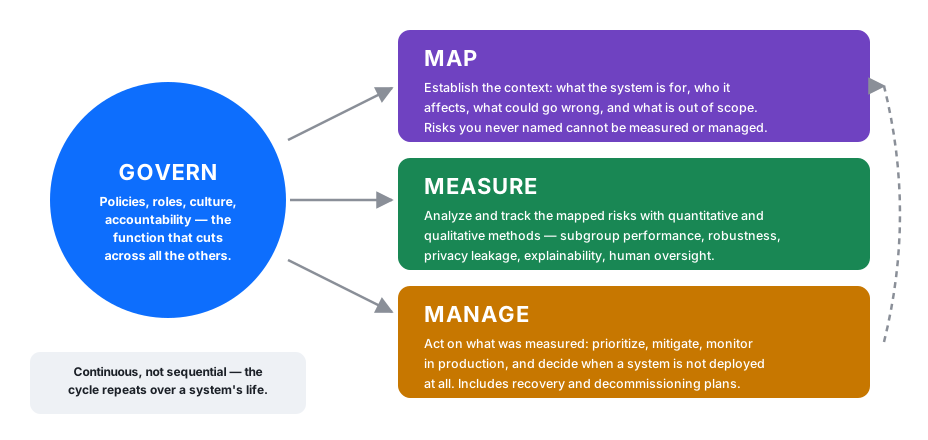
And into law
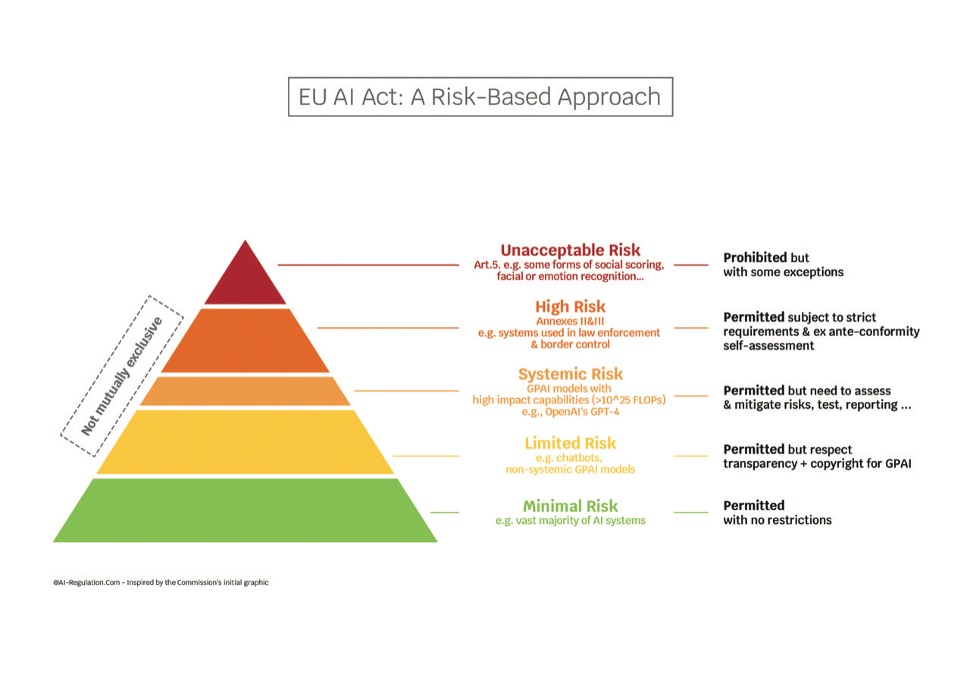
The EU AI Act regulates by risk tier rather than by technology, which is why the same neural network can be unregulated in one product and prohibited in another. A handful of practices are banned outright — social scoring, manipulative techniques that exploit vulnerability, and inferring emotions in workplaces and schools among them, in force since February 2025. High-risk uses, including employment, education, and essential services, carry obligations for data quality, logging, documentation, and human oversight.
Note where the pyramid puts most systems: at the bottom, unregulated. The Act is not a licence regime for AI, it is a targeted intervention at the top two tiers.
The documentation layer
Datasheets for datasets
Motivation, composition, collection process, preprocessing, recommended uses. Answering the questions honestly is itself the audit — most of the hard ones have no good answer for a scraped corpus.
Model cards
Intended use, out-of-scope use, and performance disaggregated by group and condition. The section that does the work is the one naming where the model should not be used.
Impact assessments
Done before deployment, with affected people consulted, and published. An assessment written after launch by the team that built the system is a press release.
Where the frameworks fall short
- The principle-to-practice gap. "Be fair" does not tell an engineer which threshold to set. Principles converge at the level of words and diverge the moment they are operationalized — which is where all the disagreement actually lives.
- Ethics washing. A published set of principles, an advisory board with no veto, and no change to any shipping decision. Voluntary frameworks are most visible in organizations facing the least pressure to change.
- Metric fixation. Once fairness is a dashboard number, the number becomes the target. A system can satisfy every measured criterion and still be the wrong system to build.
- Whose ethics. Most influential frameworks were written in a handful of wealthy countries, by the institutions building the systems, and the people most affected are rarely in the room when the trade-offs are set.
- Nothing forces the prior question. Every framework helps you build the system responsibly. Few give you a procedure for concluding that it should not be built, and that is the decision with the largest effect.
- What inner state is being inferred, and what is the evidence that it can be inferred from this signal at all?
- Whose data trained it, under what consent, and what can be derived from it that was never disclosed?
- What is the target variable really measuring — and is it a proxy standing in for what you care about?
- What is the performance per group, on data resembling deployment rather than the benchmark?
- Which fairness criterion did you choose, what does that choice give up, and who decided?
- Who can contest an output, on what evidence, and who is accountable when it is wrong?
Governing a system, governing a mind
Human institutions hold people responsible by demanding reasons — a diagnosis, a verdict, a rejection all come with a justification that can be challenged. Explicability asks machines for the same thing, and for the same purpose.
A person who decides badly can be questioned, sanctioned, and expected to do better. A model has no intentions to interrogate and nothing at stake, so responsibility has to be assigned by design — or it lands on whoever was standing closest.
Tools & Tutorials
- Fairlearn — open-source Python toolkit for assessing and mitigating unfairness, with a user guide that explains the metrics conceptually and example notebooks working through a real credit-default model.
- AI Fairness 360 — IBM Research's toolkit, with an interactive web demo that walks you through checking and remediating bias step by step before you write any code; 70+ fairness metrics and 10+ mitigation algorithms behind it.
- Google ML Crash Course — Types of Bias — a short interactive module with expandable examples and an exercise on identifying bias in an admissions dataset; the clearest quick introduction to the vocabulary.
- NIST AI RMF Playbook — suggested concrete actions for each outcome in the framework, downloadable as PDF, CSV, Excel or JSON so it can be dropped straight into an existing risk process.
- Hugging Face model cards — the documentation and template for writing one, including the annotated guide explaining what belongs in each section. The fastest way to see the practice rather than read about it.
Further reading
- Floridi, L., et al. (2018). AI4People — An Ethical Framework for a Good AI Society. Minds and Machines, 28(4), 689–707. — the synthesis of six principle sets into five principles, and the argument for explicability as the one AI had to add.
- Kleinberg, J., Mullainathan, S., & Raghavan, M. (2016). Inherent Trade-Offs in the Fair Determination of Risk Scores. arXiv:1609.05807. — the impossibility proof. The formal core is short and worth reading in the original rather than in summary.
- Buolamwini, J., & Gebru, T. (2018). Gender Shades: Intersectional Accuracy Disparities in Commercial Gender Classification. PMLR, 81, 77–91. — the audit that made intersectional evaluation standard practice.
- Obermeyer, Z., Powers, B., Vogeli, C., & Mullainathan, S. (2019). Dissecting Racial Bias in an Algorithm Used to Manage the Health of Populations. Science, 366(6464), 447–453. — the clearest demonstration that the choice of target variable, not the choice of features, is where bias often lives.
- Mitchell, M., et al. (2019). Model Cards for Model Reporting. FAT* '19. — the proposal that made disaggregated reporting a norm.
- Gebru, T., et al. (2018/2021). Datasheets for Datasets. Communications of the ACM, 64(12). — the companion for data; the question list is directly usable on your own corpus.
- UNESCO (2025). Recommendation on the Ethics of Neurotechnology (PDF). — the first global standard on neural data, mental privacy, and cognitive liberty, adopted November 2025.
- European Commission — Regulatory Framework for AI — the official explanation of the risk tiers, the prohibited practices, and the staged application dates through 2028.