
From Finite Words to Infinite Words
A standard finite automaton reads a finite string w ∈ Σ* and accepts or rejects based on whether its final state is accepting. But what does "final state" mean when the input never ends? An ω-word (omega-word) is an infinite sequence α = a₀a₁a₂… over an alphabet Σ. The set of all ω-words over Σ is denoted Σω. An ω-language is any subset L ⊆ Σω.
Since the automaton never halts on an infinite input, the acceptance condition cannot depend on a single final state. Instead, it must depend on the long-run behaviour — which states are visited infinitely often during the run. This shift from "where you end up" to "where you keep returning" is the key insight behind ω-automata.
An ω-automaton is a tuple A = (Q, Σ, δ, q₀, Acc) where Q is a finite set of states, Σ is a finite alphabet, δ is a transition function (or relation), q₀ is the initial state, and Acc is an acceptance condition defined over infinite runs. A run of A on an ω-word α = a₀a₁a₂… is an infinite sequence of states ρ = q₀q₁q₂… such that qᵢ₊₁ ∈ δ(qᵢ, aᵢ) for all i ≥ 0. The run ρ is accepting if it satisfies the acceptance condition Acc. Different choices of Acc yield different types of ω-automata.
For an infinite run ρ = q₀q₁q₂…, define Inf(ρ) = {q ∈ Q | q = qᵢ for infinitely many i}. This is the set of states that appear infinitely often in the run. All ω-automata acceptance conditions are defined in terms of Inf(ρ).
Types of ω-Automata
The four principal types of ω-automata differ only in their acceptance conditions. They turn out to have deep relationships — and, in the nondeterministic case, equivalent expressive power.
Büchi Automata
A Büchi automaton has a set F ⊆ Q of accepting states. A run ρ is accepting if and only if Inf(ρ) ∩ F ≠ ∅ — that is, at least one accepting state is visited infinitely often. Büchi automata are the simplest and most widely used ω-automata. They were introduced by Julius Richard Büchi in 1962.
- Language: L = {α ∈ {a, b}ω | a appears infinitely often in α}
- Büchi automaton: Two states: q₀ (initial, accepting) and q₁. Transitions: δ(q₀, a) = q₀, δ(q₀, b) = q₁, δ(q₁, a) = q₀, δ(q₁, b) = q₁.
- Intuition: The automaton returns to q₀ every time it reads an 'a'. If 'a' appears infinitely often, q₀ ∈ Inf(ρ), so the run accepts. If only finitely many a's appear, the run eventually stays in q₁ forever and rejects.
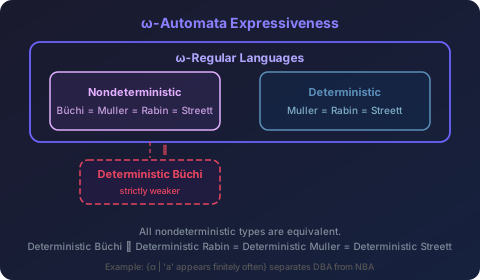
Deterministic Büchi automata (DBA) are strictly less expressive than nondeterministic Büchi automata (NBA). The language {α ∈ {a, b}ω | a appears only finitely often} is recognised by an NBA but by no DBA. This is a stark contrast with finite automata, where deterministic and nondeterministic models have equal power. The gap arises because a deterministic automaton must commit to a single run, and Büchi acceptance requires guessing when the last relevant event occurs.
Muller Automata
A Muller automaton specifies a collection ℱ ⊆ 2Q of acceptable state sets. A run ρ is accepting if and only if Inf(ρ) ∈ ℱ — the set of states visited infinitely often must exactly match one of the sets in ℱ. Muller automata are the most general ω-automata: they can express any condition on Inf(ρ). Deterministic Muller automata recognise exactly the ω-regular languages.
Rabin and Streett Automata
A Rabin automaton has a set of pairs Ω = {(L₁, U₁), …, (Lₖ, Uₖ)} where Lᵢ, Uᵢ ⊆ Q. A run ρ is accepting if there exists some pair (Lᵢ, Uᵢ) such that Inf(ρ) ∩ Lᵢ = ∅ and Inf(ρ) ∩ Uᵢ ≠ ∅. Intuitively: some "bad" set is visited only finitely often while some "good" set is visited infinitely often.
A Streett automaton uses the same pair structure but with the dual condition: a run is accepting if for every pair (Lᵢ, Uᵢ), either Inf(ρ) ∩ Uᵢ = ∅ or Inf(ρ) ∩ Lᵢ ≠ ∅. Streett acceptance is the complement of Rabin acceptance — making complementation trivial by swapping automaton type.
- Nondeterministic Büchi, Muller, Rabin, and Streett automata all recognise exactly the ω-regular languages.
- Deterministic Büchi automata are strictly weaker. Deterministic Muller, Rabin, and Streett automata all recognise the full class of ω-regular languages.
- The standard conversion from NBA to deterministic Rabin automaton uses Safra's construction (1988), producing an automaton with 2O(n log n) states — a doubly-exponential blowup that is known to be optimal in the worst case.
- Büchi's theorem (1962): a language L ⊆ Σω is ω-regular if and only if it can be expressed as a finite union of sets of the form U · Vω, where U and V are regular languages of finite words and V does not contain the empty string.
Applications in System Verification
The primary motivation for ω-automata comes from model checking — the automated verification of reactive systems. A reactive system (an OS kernel, a communication protocol, a control system) is not a batch program that terminates; it runs indefinitely, continuously interacting with its environment. Its correctness is defined by properties of its infinite execution traces.
Linear Temporal Logic (LTL) and Automata
LTL is a logic for expressing properties of infinite sequences. Its formulas are built from atomic propositions using Boolean connectives and temporal operators: Xφ ("next": φ holds at the next step), Fφ ("finally/eventually": φ holds at some future step), Gφ ("globally/always": φ holds at every future step), and φ U ψ ("until": φ holds until ψ becomes true). Common specifications include:
- Safety: G(¬error) — "an error state is never reached."
- Liveness: G(request → F grant) — "every request is eventually granted."
- Fairness: GF(enabled → X executed) — "if a process is enabled infinitely often, it executes infinitely often."
The Automata-Theoretic Approach to Model Checking
The connection between LTL and Büchi automata is the foundation of automata-based model checking, first developed by Vardi and Wolper in the 1980s. The approach works as follows:
- Step 1 — Model the system: Represent the system as a Büchi automaton Asys (or equivalently, a Kripke structure). The language L(Asys) is the set of all possible infinite execution traces.
- Step 2 — Specify the property: Express the desired property φ in LTL. Negate it to get ¬φ (the "bad" behaviours). Convert ¬φ into an NBA A¬φ. This conversion is exponential in |φ| but φ is typically small.
- Step 3 — Check emptiness: Compute the product automaton Asys × A¬φ. The system satisfies φ if and only if L(Asys) ∩ L(A¬φ) = ∅. Emptiness of a Büchi automaton reduces to checking for a reachable accepting cycle — solvable in linear time using nested depth-first search or Tarjan's SCC algorithm.
- Step 4 — Counterexample: If the intersection is non-empty, the accepting run provides a concrete counterexample: a prefix (reaching the cycle) followed by a repeating suffix (the cycle itself) — an infinite trace that violates φ.
- SPIN (Simple Promela Interpreter) is the most widely used explicit-state LTL model checker. It implements exactly the Vardi-Wolper automata-theoretic approach. SPIN has been used to verify NASA spacecraft protocols, telephone switching systems, and flood control software.
- Hardware verification: Intel, AMD, and ARM use model checking (often with CTL or LTL properties translated to automata) to verify processor designs before fabrication. A bug found pre-silicon saves millions of dollars.
- The 2007 Turing Award was awarded to Clarke, Emerson, and Sifakis for their foundational work on model checking — a technique built directly on ω-automata theory.
Constructing ω-Automata: Worked Examples
Example 1: "Finitely Many a's"
- Intuition: After some point, the word consists entirely of b's. The automaton must guess when the last 'a' occurs and then verify that no more a's follow.
- NBA construction: States: q₀ (initial), q₁ (accepting). Transitions: δ(q₀, a) = {q₀}, δ(q₀, b) = {q₀, q₁}, δ(q₁, b) = {q₁}. No transition from q₁ on 'a'.
- How it works: The automaton nondeterministically transitions from q₀ to q₁ at some point while reading 'b'. Once in q₁, it can only read b's — if an 'a' arrives, the run dies. The accepting run (visiting q₁ infinitely often) exists if and only if a's eventually stop.
- Why deterministic Büchi fails: A DBA must commit to transitioning at a specific moment, but it cannot know when the last 'a' will occur. No DBA recognises this language — a formal proof uses a pumping-style argument on ω-regular sets.
Example 2: Mutual Exclusion
- Alphabet: Σ = {idle, req₁, req₂, cs₁, cs₂} (simplified: each symbol indicates the system state at that step).
- Safety component (mutual exclusion): A DBA with a single non-accepting "trap" state reached whenever both processes are in the critical section simultaneously. The automaton stays accepting as long as at most one csᵢ is active at any step.
- Liveness component (no starvation): For each process pᵢ, build an NBA that accepts words where reqᵢ occurs infinitely often but csᵢ occurs only finitely often (starvation). The complement of this NBA accepts the good behaviours. Using the product construction, combine both components.
- Verification use: The product of this specification automaton with the system model is checked for emptiness. An accepting run in the product corresponds to a trace violating the specification — a bug.
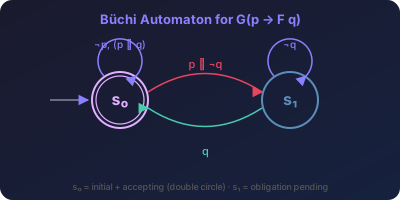
Example 3: LTL to Büchi — G(p → F q)
- LTL formula: G(p → F q) means "globally, whenever p holds, q will eventually hold in the future."
- NBA construction: States: s₀ (initial, accepting), s₁ (obligation pending). Alphabet: subsets of {p, q}.
- Transitions: From s₀: if the current symbol contains p but not q, move to s₁ (obligation created); otherwise stay in s₀. From s₁: if the current symbol contains q, move to s₀ (obligation fulfilled); otherwise stay in s₁.
- Acceptance: s₀ is the sole accepting state. The run accepts iff it returns to s₀ infinitely often — meaning every obligation is eventually discharged. If the run gets stuck in s₁ forever (p happened but q never follows), s₀ ∉ Inf(ρ) and the run rejects.
Closure Properties and Decision Problems
The ω-regular languages enjoy strong closure properties that make them suitable for compositional verification — building complex specifications from simpler pieces.
- Union: If L₁ and L₂ are ω-regular, so is L₁ ∪ L₂. Construct the union NBA by combining initial states with ε-transitions (or using a standard product construction).
- Intersection: L₁ ∩ L₂ is ω-regular. The product construction for Büchi automata requires a three-state acceptance tracking mechanism to ensure both automata accept — slightly more involved than the finite-word case.
- Complementation: The complement of an ω-regular language is ω-regular. However, complementing an NBA is hard: the best known construction (via Safra's determinisation then complementation) produces an automaton of size 2O(n log n). This complexity is a major bottleneck in model checking tools.
- Emptiness: Given an NBA, L(A) = ∅ if and only if no accepting state is reachable from the initial state via a cycle. This is decidable in linear time (O(|Q| + |δ|)) using SCC decomposition — the key algorithmic step in model checking.
- Language inclusion: L(A) ⊆ L(B) is decidable but PSPACE-complete. It reduces to checking emptiness of L(A) ∩ L(B)ᶜ, requiring complementation of B.